Why Your Business Isn’t Showing Up in AI Search
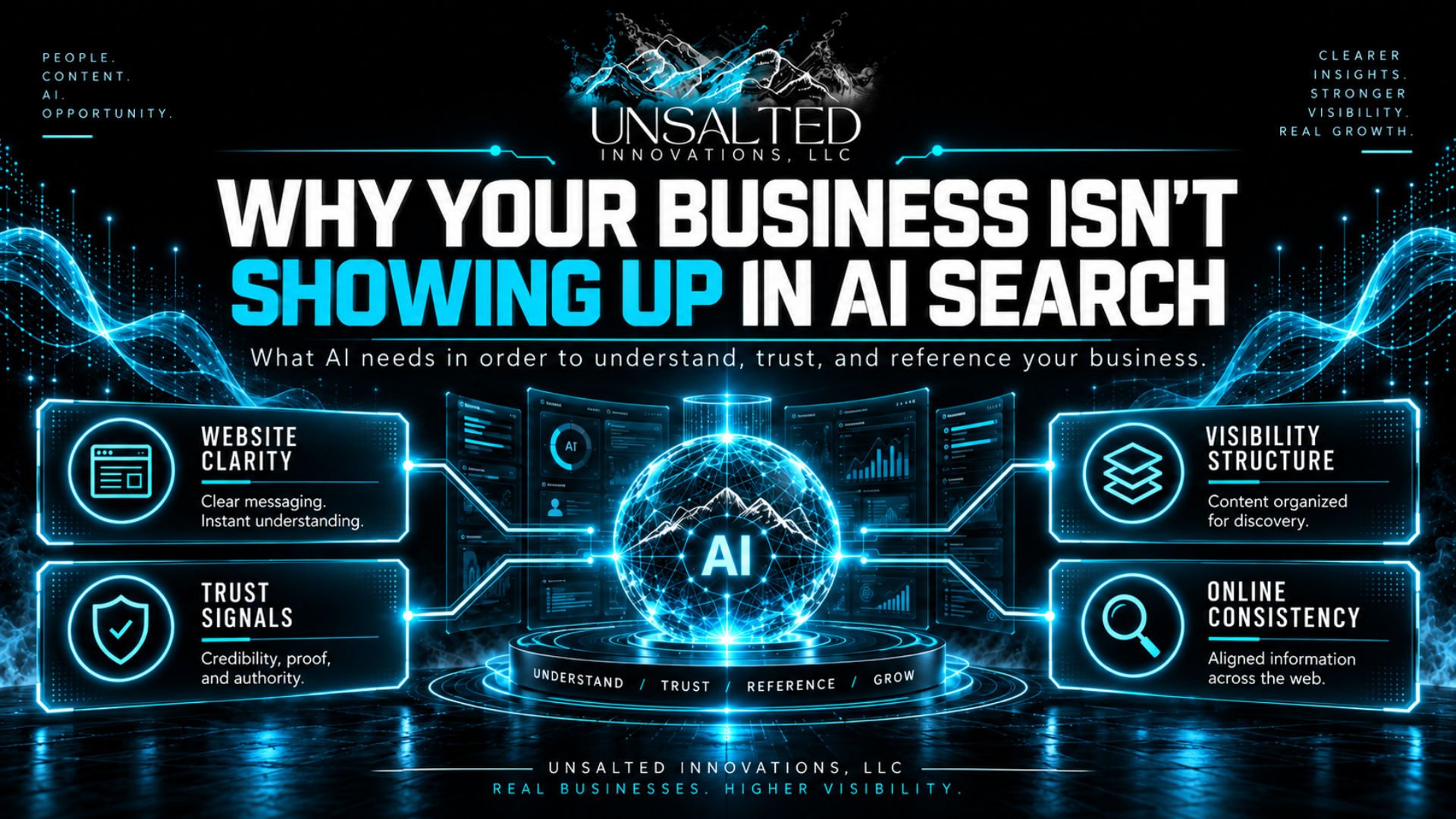
One of the questions I hear most often from business owners is some version of:
“I know we are good at what we do, so why aren’t we showing up when I ask AI for businesses like mine?”
When I hear that, I start by looking at what the business has actually made available online.
A company may have years of experience while its website gives a very general description of the service. Strong customer reviews may exist without being connected to the work they support. A new specialty may have become an important part of the business while older descriptions are still sitting on directories, profiles, and website pages.
Sometimes an important page cannot be found easily. Sometimes the business simply has more expertise than its digital presence currently shows.
Those are the kinds of gaps I look for through Signal Sync™ AI Visibility Alignment.
There is no single reason a business fails to appear in an AI-generated answer, and one test in one platform is not enough to diagnose the problem. Results can vary by the question, wording, platform, location, available sources, and the systems being used at that moment.
What we can do is look closely at the information those systems have available to work with.
Start by Looking at Non-Branded Searches
A branded search uses your company or personal name.
Someone asking:
“What does Unsalted Innovations do?”
already knows the business exists.
A non-branded search begins earlier in the customer journey:
“Who can help my business improve its AI visibility?”
“Who builds websites for AI search?”
“Who can audit my website for AI visibility?”
“What companies help service businesses show up more clearly in AI search?”
Those searches tell me something different.
They help me look at whether a business can be connected to the services and expertise it wants to be known for when the person searching does not already know its name.
That is one reason I test both branded and non-branded searches inside AI visibility work.
I am interested in whether the online presence gives enough useful context for the business to belong in the conversation before someone already knows who they are.
1. An Important Page May Not Be Available to Search in the First Place
For Google specifically, this is one of the first things worth checking.
In Google’s guidance for AI features and your website, Google explains that a page must be indexed and eligible to appear in Google Search with a snippet before it can be eligible as a supporting link in AI Overviews or AI Mode. Google also says there are no additional technical requirements just for those AI features.
That means I still care about basic questions such as:
Can Google crawl the page?
Is the page indexed?
Is an important service buried somewhere with very few internal links pointing to it?
Has a page accidentally been blocked?
Is Google seeing the current version of the page?
Does the website have a logical path connecting related services and resources?
A beautifully written page has limited search value if Google cannot reliably discover or index it.
This is one reason modern SEO remains part of Signal Sync™.
2. Your Website May Be Saying Less Than You Think
This is one of the most common things I notice.
The business owner knows the service so well that a short description feels obvious to them.
The person arriving for the first time does not have that background.
A website might say:
“We provide customized solutions designed around your needs.”
That could describe almost anything.
I want to know what the service actually is, what situations lead someone to need it, what the process involves, what experience sits behind it, and what someone should understand before deciding whether it is right for them.
This does not require turning every page into an encyclopedia.
It requires enough specificity for the business to make sense.
When service information stays vague, there is less meaningful context available for a customer, search engine, or AI-assisted system to connect with the questions people are asking.
3. Your Services May Be Grouped Too Broadly
I see this frequently on small-business websites.
Several distinct services are placed on one general page because that was easier when the website was first built.
Over time, those services become more specialized.
One might serve a different customer.
Another might solve a completely different problem.
A third may become one of the highest-value services in the business.
The website still gives all three a paragraph each.
That can create a visibility gap because there is very little room to explain the experience, customer questions, process, supporting proof, and related information around each service.
Sometimes the right solution is a stronger shared service page.
Sometimes a service has earned its own page.
I make that decision based on the business and the usefulness of the information, rather than creating a separate URL for every possible search variation.
Google’s current generative Search guidance specifically warns against creating large numbers of pages simply to capture long-tail query variations.
4. The Business Has Changed, but the Internet Still Shows Pieces of the Old Version
This is a visibility issue I understand personally because I recently caught it on my own website.
Unsalted Innovations is based in Knoxville, Tennessee, and my Signal Sync™ services are available to businesses throughout the United States.
While reviewing my own digital presence, I found older footer language that still said I was “serving East Tennessee.”
That statement had been accurate for an earlier stage of the business.
It no longer reflected the reach of the services I was actively offering.
That is exactly the kind of disconnect I look for with clients.
A company may have:
an old service area in a footer
an outdated description in a directory
a Google Business Profile category that no longer reflects the core work
old services still appearing on social profiles
inconsistent names for the same offer
an About page describing a previous stage of the business
different phone numbers, locations, or business descriptions across platforms
Individually, those details can look minor.
Together, they can create a much less consistent picture of the business.
5. Your Trust Signals May Exist Without Supporting the Services You Want to Be Known For
Businesses often have more proof than they realize.
Reviews may repeatedly mention the same strength.
Clients may describe a specific result.
A founder may have years of relevant professional experience.
The company may have portfolio work, credentials, media coverage, community involvement, interviews, testimonials, or project results.
Then I look at the service page and barely see any of it.
Trust signals are more useful when there is a clear relationship between the evidence and the claim being made.
If a company says it has deep experience in a particular service, I want to know what information online helps support that.
This is one reason case studies have become increasingly important in my own work.
A good case study gives us room to document the starting point, the decisions made, the work completed, and the results without reducing an entire project to a testimonial sentence.
6. Your Expertise May Still Be Living Mostly Offline
This may be one of the largest missed opportunities I see.
A plumber knows which homeowner question often points to a larger problem.
A REALTOR® understands which concerns start coming up when a buyer becomes serious about a particular area.
A designer can explain decisions behind a transformation that the finished photograph cannot show.
A boutique owner learns exactly where customers become confused about fit, sizing, materials, styling, and care.
A consultant starts recognizing the same pattern after helping client after client solve a particular problem.
That information usually comes out naturally in conversation.
It does not always make its way onto the website.
Google’s current guidance puts considerable emphasis on unique, useful, non-commodity information grounded in firsthand knowledge, original perspective, and deeper experience. Its broader guidance around helpful, reliable, people-first content also asks site owners to consider originality, expertise, sourcing, and whether the content offers substantial value.
For many businesses, stronger authority content begins with documenting more of what they already know.
7. Your Content May Be Too Generic to Add Much Context
Publishing more does not automatically create stronger visibility.
If ten competitors could replace your company name with theirs and publish essentially the same article, I would question what the page is contributing.
Generic content often happens when businesses begin with a topic instead of their own knowledge.
“5 Tips for Choosing a Plumber.”
“10 Reasons to Hire a REALTOR®.”
“7 Benefits of Professional Marketing.”
There may be situations where a basic educational article is useful, but I do not want the entire content strategy built from interchangeable topics.
I am much more interested in questions such as:
What are customers consistently misunderstanding?
What changed your professional opinion after years of doing this work?
What does a real project teach someone?
What question do you wish customers asked earlier?
What problem are you seeing repeatedly?
What can you explain from experience that another website cannot simply summarize?
That is the kind of content that gives a business a more distinct body of information online.
8. Your Pages May Exist Without Enough Connection Between Them
A website can contain useful information and still make that information difficult to navigate.
A service page may never link to the case study proving the work.
A blog may answer a valuable customer question without pointing back to the relevant service.
The About page may contain the founder’s strongest expertise while none of the educational content identifies that person as the author.
A location page may exist without being connected to the service pages it supports.
Google specifically includes internal linking among the SEO fundamentals that continue to matter for its AI features.
I think about internal links in a very practical way.
If someone is reading this page, what related information would genuinely help them understand the subject better?
That is the same way I have structured my own AI visibility resources.
You can move from this article into my Complete AI Visibility Guide for the deeper methodology, my AI Search Questions for Businesses resource for specific technical questions, or my AI Visibility Alignment for Businesses page to understand how Signal Sync™ applies this work to an actual business.
Those relationships are useful to the reader first.
They also give the website a clearer structure around the subject.
9. Your Geographic Reach May Be Unclear
This matters for both local and nationwide businesses.
A local service provider needs clear information about where the company actually works.
A remote consultant may have the opposite problem: the website talks so heavily about the city where the business is based that someone researching providers nationally assumes the service is local only.
The answer is accuracy.
If you serve Knoxville, say Knoxville.
If you serve several counties, explain them clearly.
If you are based in Tennessee and work with clients throughout the United States, the website should make both facts easy to understand.
I look at this across service pages, footer information, Google Business Profile where applicable, About content, structured data, directories, and the other places geographic information is being repeated.
10. You May Be Judging Visibility From Too Few Searches
AI search results can vary.
The same platform may respond differently to slightly different questions.
Different platforms may rely on different retrieval systems, data sources, models, or product features.
Google itself says AI Overviews and AI Mode can use different models and techniques and may show different responses and links.
So I would not diagnose an entire business from:
“I asked ChatGPT once and it didn't mention me.”
When I am assessing visibility, I am more interested in patterns.
How does the business appear in branded searches?
What happens in non-branded service searches?
What services are consistently understood correctly?
Where does the description become vague or inaccurate?
Which sources are appearing?
Does the business show up for one area of expertise but disappear around another?
That gives us something useful to investigate.
What I Check Before Recommending a Fix
When a business comes to me because it is not appearing where expected, I work through the underlying digital presence before deciding what should be changed.
That usually includes some combination of:
crawlability and indexing
homepage and service-page clarity
business positioning
service definitions
geographic information
internal linking
trust and authority signals
reviews
case studies
original expertise
existing content
Google Business Profile where applicable
third-party business information
metadata
structured data where it serves a real purpose
accessibility and website usability
Agent Readiness
branded and non-branded AI visibility testing
The answer is different from one business to another.
A company with excellent content may have a technical problem.
Another may have a technically healthy website with very little useful service information.
Another may have years of authority sitting in reviews and client work that has never been connected back to the website.
That is why I prefer to diagnose the actual gap first.
A Real Example: Friendly Neighborhood Plumber
When I worked with Friendly Neighborhood Plumber in Knoxville, the business already had real services, customer experience, and local expertise.
The website needed to communicate those things more clearly.
The Signal Sync™ implementation included stronger plumbing service pages, clearer Knoxville-area positioning, improved website organization, internal linking, trust signals, and a structure that better reflected what the company actually provided.
During the first month after implementation, Google Analytics showed a 447.27% increase in active users, 145.74% increase in website views, 253.19% increase in sessions, and 40% increase in organic search sessions compared with the previous period. These are website and search-performance results rather than proof of guaranteed placement in an AI-generated response.
The Friendly Neighborhood Plumber Signal Sync™ case study walks through the project in more detail.
What I value most about that project is that we did not need to manufacture expertise for the business.
We needed to represent more of what was already true.
When an AI Visibility Audit Makes Sense
An audit becomes useful when you know visibility is not where you want it to be but the reason is still unclear.
You may have several things happening at once:
The business has changed.
The website has grown without a clear structure.
Important services are underdeveloped.
Reviews and customer proof are scattered.
Older information remains online.
You have strong expertise but very little authority content.
Search performance is inconsistent.
AI tools understand some parts of the business and miss others.
The Signal Sync™ AI Visibility Audit gives me a place to look at those relationships together before recommending implementation.
I review the current website and relevant online signals, identify the areas worth addressing, and organize the recommendations by priority.
If the website itself needs deeper work, I also provide Signal Sync™ Website + AI Visibility Implementation for businesses throughout the United States.
About the Author
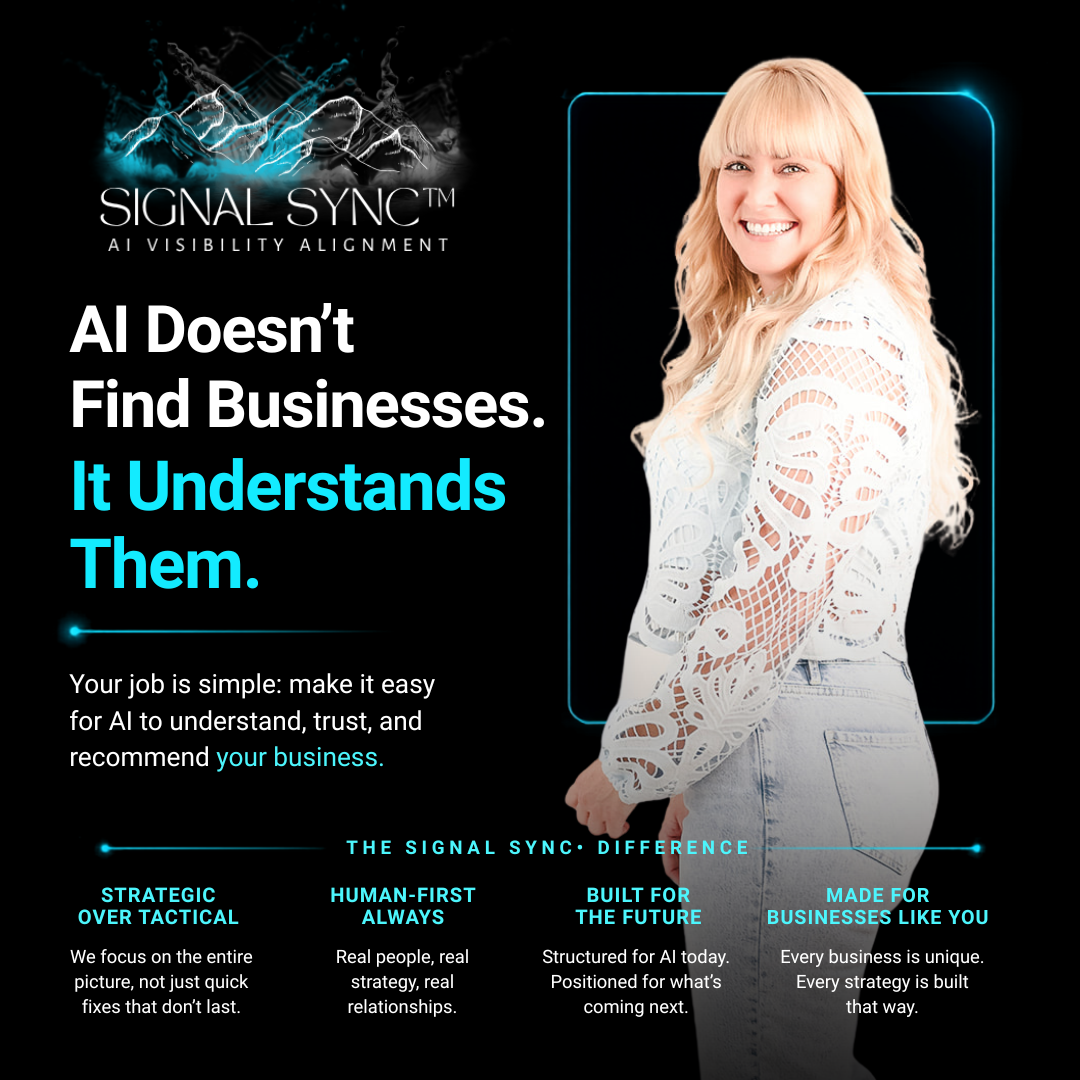
I'm Brianna Sybesma, founder of Unsalted Innovations, LLC and creator of Signal Sync™ AI Visibility Alignment.
My work brings together website strategy, marketing, modern SEO, content development, brand clarity, technical systems, and the way AI-assisted search is influencing how businesses are researched and understood online.
Signal Sync™ grew from patterns I kept finding in real client work: businesses often had far more expertise, customer proof, useful information, and clarity than their digital presence communicated.
My approach is rooted in Humane Technology. I use technology to support clearer communication and stronger visibility while protecting the voice, experience, values, and relationships behind the business.
Unsalted Innovations is based in Knoxville, Tennessee, and I work with businesses throughout the United States.
Learn more about Brianna Sybesma and Unsalted Innovations.
Written and reviewed by Brianna Sybesma
Creator of Signal Sync™ AI Visibility Alignment
Updated September 2026
If Your Business Is Missing From AI Search, Find the Gap Before You Start Rebuilding
There may be something technical to fix.
There may be useful information missing from the website.
The business may have changed faster than its online presence.
Your strongest authority may already exist in reviews, client work, customer conversations, and years of experience that have never been documented properly.
The $297 Signal Sync™ AI Visibility Audit is where I look at what is actually online, identify the gaps that matter, and give you a prioritized plan for what should happen next.
Your business. Your voice. Sync to the rhythm of AI.