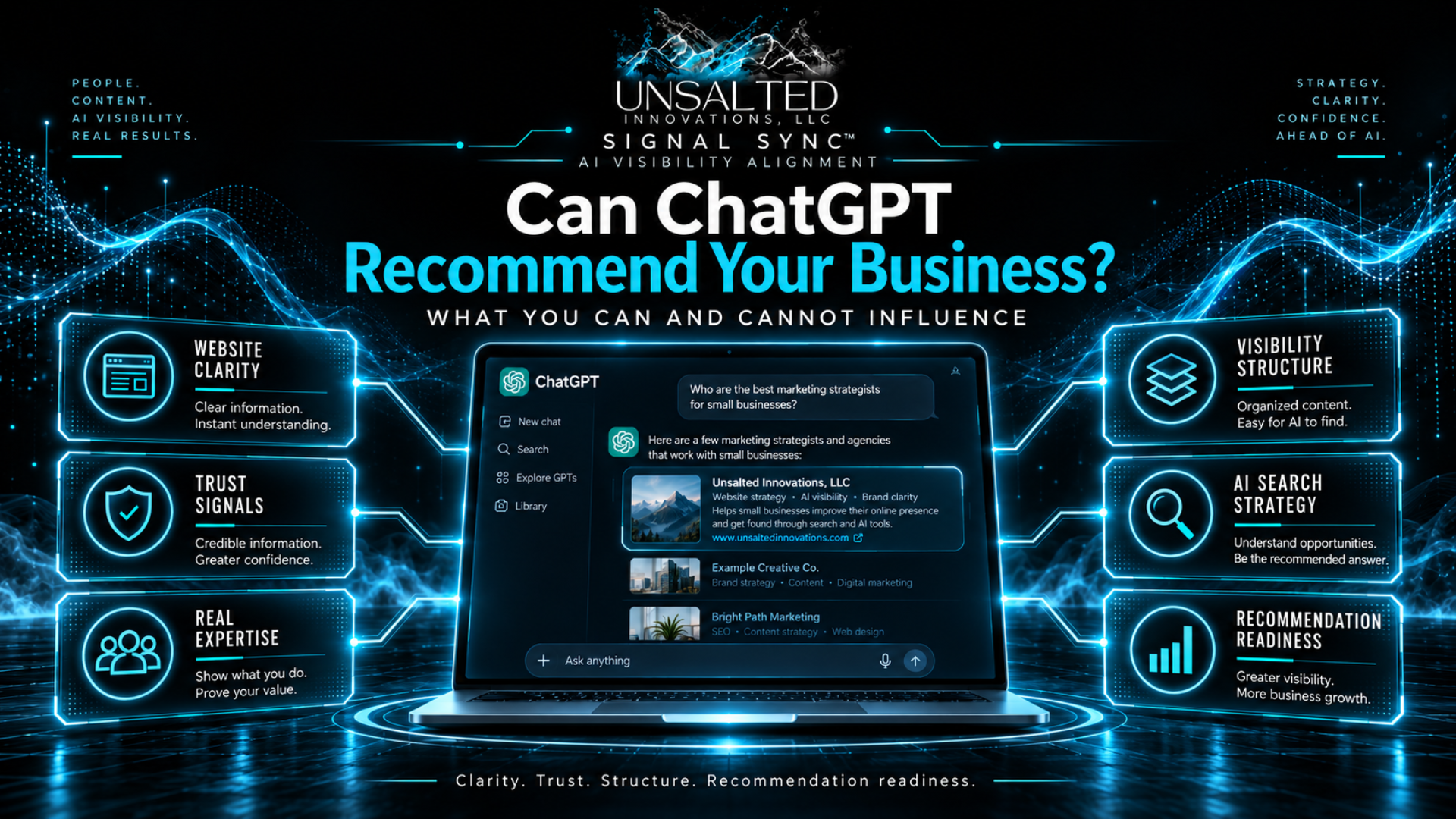
A business owner recently asking me whether ChatGPT can recommend their company is usually asking something deeper:
“How do I become one of the businesses AI considers when someone asks who to hire?”
Yes, ChatGPT can mention businesses, surface websites, provide links to sources, and help people research providers.
But there is an important distinction between being available for consideration and controlling whether ChatGPT ultimately recommends you.
OpenAI says ChatGPT Search uses multiple factors intended to help people find relevant and reliable information, and it explicitly states that placement is not guaranteed.
There is no setting I can turn on that tells ChatGPT:
Recommend this company next time someone asks.
What I can work on is the information available before that answer is created.
That is one of the reasons I created Signal Sync™ AI Visibility Alignment.
The framework helps me look at whether a business is accurately represented, whether its website can be found, whether its expertise is documented, whether the services are clear, whether useful evidence supports those services, and whether the broader online presence still reflects the company as it exists today.
That creates a much more realistic goal than promising control over an independent AI platform.
How Does ChatGPT Find Current Information About Businesses?
ChatGPT does not answer every question in exactly the same way.
OpenAI explains that ChatGPT can search the web when a question would benefit from current information, and users can also explicitly choose Search. Responses that use web search may include citations linking people to the sources used in the answer.
That matters for businesses because current information can come from the public web.
OpenAI also says that public websites can appear in ChatGPT Search.
To help make website content discoverable and eligible to be included in search summaries and snippets, OpenAI tells publishers to allow its OAI-SearchBot crawler to access the site.
That gives us one concrete technical thing to verify.
It still does not tell us exactly which business ChatGPT will select for a particular recommendation question.
OpenAI does not publish a formula that says:
30% reviews + 20% schema + 15% backlinks + 10% blog content = ChatGPT recommendation.
If someone sells you that formula as though it came directly from OpenAI, I would ask to see the source.
Branded Search and Recommendation Search Tell Me Different Things
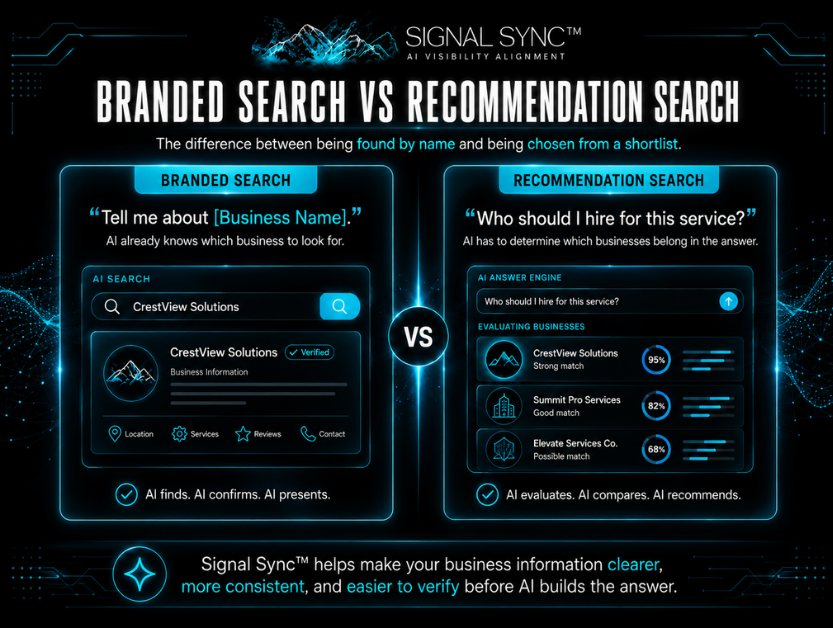
Inside Signal Sync™, I separate two kinds of testing.
I call the first branded search.
For example:
“Tell me about Unsalted Innovations.”
I have already told the system which company to investigate.
The question is whether it can find and describe the business accurately.
Then there is what I call recommendation search.
For example:
“Who can help my business improve its AI visibility?”
Now I have not supplied a company name.
The system has to determine which businesses, sources, or experts are relevant to the question.
That makes recommendation-style searches much more interesting to me when a business wants to grow through non-branded discovery.
The question becomes:
Is there enough accurate public information connecting this company to the service or expertise someone is asking about?
That is something we can investigate.
It is still different from claiming we know exactly why ChatGPT selected one provider instead of another.
Can You Make Your Website Available to ChatGPT Search?
Yes.
This is one of the clearer things OpenAI has documented.
OpenAI says any public website can appear in ChatGPT Search and recommends allowing OAI-SearchBot if you want your site's content to be discoverable, surfaced, cited, and linked through Search.
That means I want to make sure a business has not unintentionally blocked OpenAI's search crawler through:
robots.txt
firewall settings
CDN or bot-protection rules
other technical restrictions
This is an eligibility and accessibility issue.
Allowing OAI-SearchBot does not guarantee that ChatGPT will cite or recommend your page.
It simply removes one possible barrier between the public website and ChatGPT Search.
That distinction matters.
OAI-SearchBot and GPTBot Are Not the Same Thing
This is another area where businesses can easily get confused.
OpenAI documents separate controls for search discovery and potential model training.
OAI-SearchBot is associated with ChatGPT Search discovery.
GPTBot is the crawler publishers can block if they want to exclude their web content from potential training use.
OpenAI's publisher documentation specifically treats those as separate controls.
So a conversation about:
“Can ChatGPT Search access my website?”
is not automatically the same conversation as:
“Do I want my website used for model training?”
For a business working on visibility, I care about that distinction because I do not want technical recommendations built on assumptions about what the crawlers actually do.
What Can a Business Realistically Influence?
This is where AI visibility becomes useful.
I cannot control ChatGPT's final answer.
I can help strengthen the public information ChatGPT Search and other systems may encounter while researching a business.
Here are the areas I pay attention to.
1. Whether the Website Can Be Accessed
If search crawlers cannot reach important pages, that creates an obvious problem.
For ChatGPT Search specifically, OpenAI recommends allowing OAI-SearchBot.
For Google visibility, Google's own crawling and indexing requirements still apply.
Technical accessibility is not exciting, but it is foundational.
2. Whether the Business Is Explained Clearly
Open the homepage without relying on everything you already know about your own company.
Would someone encountering it for the first time understand:
what you do
which services you offer
where you work
who the services are appropriate for
what makes those services different
what expertise sits behind them
and what to do next?
A company may be extremely good at what it does while its website remains surprisingly vague.
That gives anyone researching the business less information to work with.
3. Whether Important Services Have Enough Context
A service name alone does not always explain the service.
I want enough useful context around an important offer for someone to understand the actual work.
That can include:
the situations that lead someone to need it
common customer questions
the process
professional considerations
the geographic reach
examples of the work
related expertise
and evidence supporting the service
This is not about writing pages for machines.
It is about publishing enough useful information for the real service to be understood.
4. Whether the Expertise Actually Exists Online
This continues to be one of the biggest gaps I find.
A business owner can explain something brilliantly in conversation.
Then I search the website and discover that none of that knowledge appears there.
Years of experience can remain invisible online because nobody thought to document:
the questions customers ask
the professional decisions happening behind the scenes
what the company has learned from real projects
mistakes it regularly prevents
patterns it notices
why it recommends one approach over another
what changed its professional opinion
or what customers should understand before hiring someone
That is why firsthand, non-commodity content has become such an important part of my Signal Sync™ work.
The online presence should contain more of the expertise the business already uses offline.
5. Whether Trust Has Context
Reviews are useful.
Case studies are useful.
Professional experience is useful.
Credentials, media coverage, interviews, project results, client outcomes, community involvement, and professional profiles can all provide useful context.
What I do not say is:
Get 47 reviews and ChatGPT will rank you higher.
OpenAI does not publish a formula like that.
Instead, I look at whether the public information gives someone researching the company meaningful evidence to evaluate.
If a business claims to specialize in something, what helps support that claim?
If customers repeatedly praise the same strength, has the website recognized that pattern?
If the company achieved a meaningful project result, has it documented what happened?
Trust becomes more useful when the evidence has a relationship to the service or expertise being discussed.
6. Whether Information Is Consistent Across the Public Web
Your website is only one place someone can encounter your business.
Other public information may include:
Google Business Profile
directories
professional listings
social profiles
review platforms
media coverage
podcast appearances
articles
industry organizations
local organizations
and third-party websites
I do not expect every description to use identical wording.
I do look for contradictions.
If your website says you serve businesses nationwide while older profiles still say you only serve East Tennessee, that creates two different versions of the business.
If a service was renamed three years ago but old terminology remains everywhere else, that deserves attention.
If a location changed and half the public information never followed, that matters.
The goal is an accurate public footprint.
I do not describe this as a guaranteed ChatGPT ranking factor because OpenAI has not told us that.
I describe it as making the public information about the business more coherent.
7. Whether Your Content Gives Someone a Reason to Choose You
Being identifiable is only part of the problem.
Someone asking:
“Who should I hire?”
is making a consideration decision.
That means a business needs more than a name and phone number online.
A potential customer may need to understand:
how you approach the work
what experience you have
what kind of clients you serve
what you believe matters
what real projects look like
what people say about working with you
how your process differs
and whether your expertise fits their situation
Those are useful pieces of information whether the research happens through Google, ChatGPT, another AI platform, or directly on the website.
This is what I mean by recommendation readiness inside Signal Sync™.
It is the term I use for how well the available digital presence supports consideration when someone is comparing options or asking for a provider.
It is not a guarantee that an AI system will recommend the business.
Does ChatGPT Always Search the Web Before Recommending a Business?
No.
That is another reason I would not treat ChatGPT recommendations like a traditional fixed search ranking.
OpenAI explains that ChatGPT can answer from its trained model and can also use Search when current or niche information would improve the response. When Search is used, ChatGPT can access current web information and provide cited sources.
That means the information available to a particular response can differ depending on how the question is handled.
For a business owner, the practical takeaway is simple:
I would rather build a strong, accurate public presence than attempt to reverse-engineer one individual answer.
Local Recommendations Can Also Depend on Location
If someone asks ChatGPT for a business near them, geographic context can matter.
OpenAI says ChatGPT Search can use general location information to improve local results, and users may also choose to share more precise location information in supported experiences.
So:
“Who is a good plumber?”
and
“Who is a good plumber near Knoxville, Tennessee?”
do not necessarily create the same research context.
For a local business, I want location and service-area information to be accurate across the website and relevant profiles.
For a business like mine that is based in Knoxville but serves businesses nationwide, I want both facts represented clearly.
The location tells someone where the company is based.
It should not accidentally imply that the service is unavailable elsewhere.
Can You Track Traffic From ChatGPT?
Yes, in some cases.
OpenAI says publishers that allow OAI-SearchBot can track referral traffic from ChatGPT through analytics platforms because links from ChatGPT Search include the utm_source=chatgpt.com parameter.
That gives businesses a first-party measurement opportunity.
If ChatGPT is sending visitors to your website, you may be able to see that traffic in your analytics.
I still would not measure AI visibility using referral traffic alone.
Someone may discover a company in an AI response and later visit the site another way.
A brand may be mentioned without receiving a click.
Different platforms handle citations and links differently.
And recommendation results themselves can vary.
Referral traffic is one useful signal inside a much larger picture.
What Can You Not Control?
This part is just as important.
You cannot control:
whether ChatGPT searches the web for a particular question
the exact search queries or sources used behind every response
which businesses ChatGPT ultimately chooses to mention
the order in which providers appear
whether your website receives a citation
whether another business is considered more relevant for a particular question
the wording of ChatGPT's final response
how the answer may vary across different prompts, contexts, locations, or future model updates
OpenAI itself says placement in ChatGPT Search is not guaranteed.
That is why I do not sell guaranteed ChatGPT rankings.
The work is in improving the parts of the digital presence we can actually influence.
What I Would Question Before Paying Someone for “ChatGPT Optimization”
I would ask more questions if someone promises:
Guaranteed ChatGPT recommendations
OpenAI says placement is not guaranteed.
A secret ChatGPT ranking formula
OpenAI says Search uses multiple factors, but it does not publish the kind of deterministic formula often claimed in marketing pitches.
A proprietary score presented as an OpenAI metric
A third-party score can be useful for analysis. It should not be presented as though it comes directly from ChatGPT's internal systems unless OpenAI actually provides it.
A crawler setting sold as the entire solution
Allowing OAI-SearchBot matters for search accessibility. It does not guarantee recommendation.
Hundreds of generic AI-generated articles
More pages do not automatically create more authority.
Manufactured mentions everywhere online
Real third-party information can provide useful context. Manufacturing the appearance of authority is something different.
A legitimate strategy should be able to explain what is documented, what is being observed through testing, and what remains uncertain.
What I Look at When a Business Is Not Being Recommended
When someone tells me:
“ChatGPT isn't recommending my business.”
I do not immediately tell them to publish more blogs.
I start investigating.
Can the website be accessed?
Are the important service pages present?
Does the business clearly explain what it does?
Is the geographic reach accurate?
Is the expertise documented?
Do relevant reviews, projects, case studies, or credentials support the service?
Is older information creating contradictions?
Are the site's most important pages connected?
What happens in branded searches?
What happens in recommendation-style searches?
Which sources appear when live search is used?
Are descriptions of the company accurate?
That is the kind of investigation I walk through in Why Your Business Isn’t Showing Up in AI Search.
Why I Do Not Want Signal Sync™ to Become “How to Manipulate ChatGPT”
That was never the point of the framework.
AI visibility is useful to me because it forces us to look more closely at whether the digital version of a business still reflects the real one.
Does the website tell the truth clearly?
Can important information be found?
Does the business's expertise exist online?
Are strong claims supported?
Is the information current?
Is the website usable?
Is the business still recognizable after we improve all of that?
Those questions support people too.
That is why Signal Sync™ is rooted in Humane Technology.
I want technology to help businesses communicate more clearly without reducing a company to whatever we think an algorithm might want this month.
What Should You Do if You Want ChatGPT to Recommend Your Business?
I would start with the pieces you actually control.
Make sure your website is publicly accessible.
Confirm that OAI-SearchBot is not unintentionally blocked if appearing in ChatGPT Search matters to you.
Make sure the business and services are explained clearly.
Document more of the expertise currently living offline.
Build useful supporting content when there is something worth saying.
Connect customer proof to the services it supports.
Correct outdated or contradictory public information.
Strengthen the relationships between relevant website pages.
Test both branded and non-branded recommendation-style questions.
Watch what sources appear.
Measure referral traffic where possible.
Then keep improving the actual digital presence rather than chasing a guaranteed answer that no consultant controls.
My AI Search Questions for Businesses resource goes deeper into many of the technical questions around AI search, crawling, SEO, schema, content, and measurement.
About the Author
I'm Brianna Sybesma, founder of Unsalted Innovations, LLC and creator of Signal Sync™ AI Visibility Alignment.
My work brings together website strategy, modern SEO, content development, brand clarity, marketing, technical systems, and AI-assisted search.
Signal Sync™ grew from a pattern I kept finding while working with businesses: the company I could hear someone explain in conversation was often much clearer, more experienced, and more distinctive than the version available online.
I created the framework to help close that gap while keeping the people, experience, values, and voice behind the business visible in the process.
Unsalted Innovations is based in Knoxville, Tennessee, and I work with businesses throughout the United States.
Learn more about Brianna Sybesma and Unsalted Innovations.
Written and reviewed by Brianna Sybesma
Creator of Signal Sync™ AI Visibility Alignment
Last reviewed September 2026
Want to Know What ChatGPT and Other AI Systems Can Currently Find About Your Business?
You do not need someone to promise you a guaranteed ChatGPT recommendation.
You need to know what information is currently available, where the gaps are, and which parts of the digital presence deserve attention first.
The $297 Signal Sync™ AI Visibility Audit reviews your website and supporting online presence, branded and non-branded visibility observations, trust signals, content, structure, and the broader information surrounding the business.
Your business. Your voice. Sync to the rhythm of AI.