
AI Visibility Alignment for Businesses
AI VISIBILITY CONSULTANT | SERVING BUSINESSES NATIONWIDEHelp search engines and AI systems clearly understand your business.
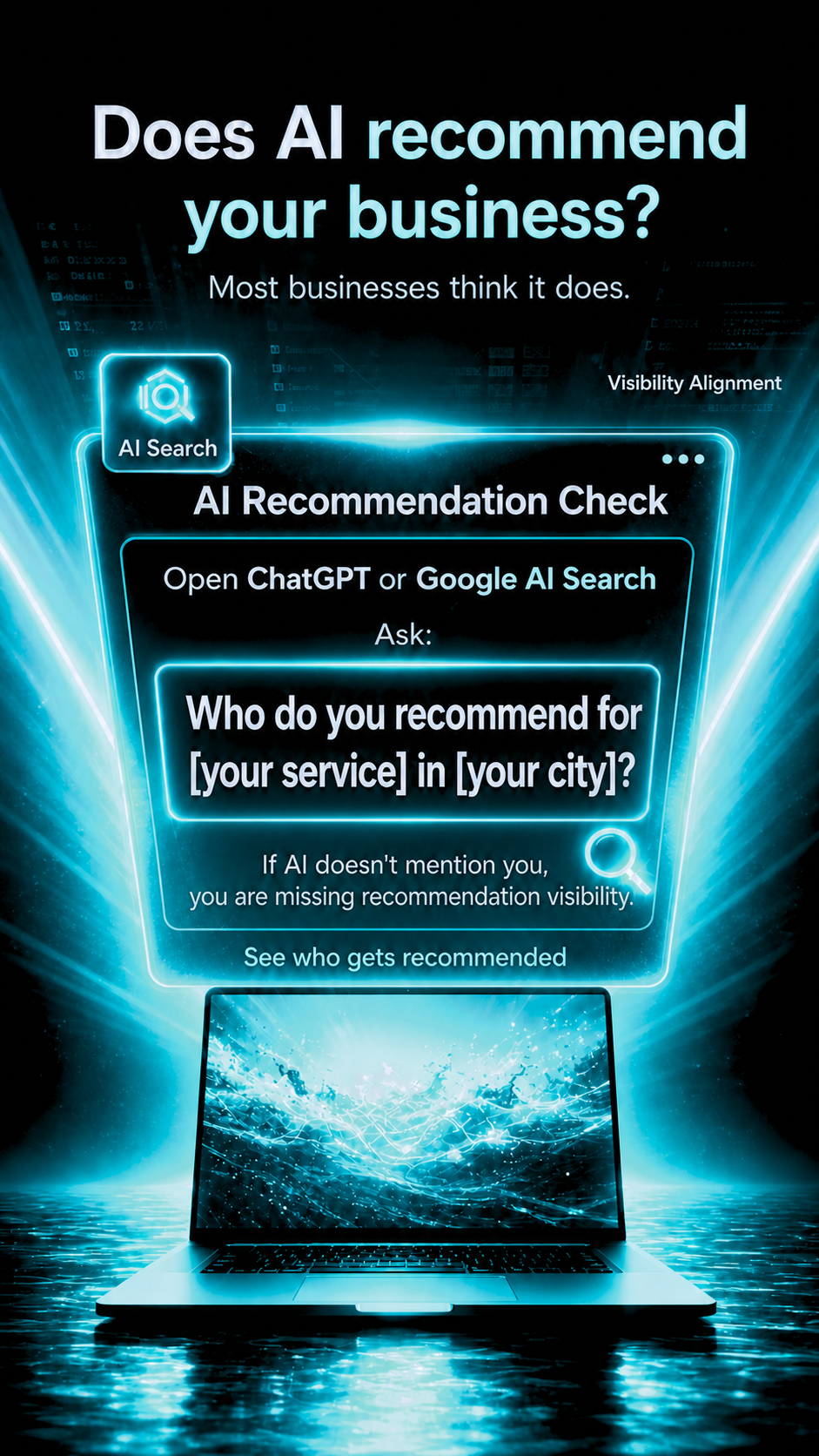
When I review a business's online presence, I rarely find a lack of experience or expertise. I usually find a gap between what the business actually knows and what has made its way online.
Services have evolved while older descriptions are still published. Strong reviews are sitting on Google while the service pages barely show the experience behind them. Business owners answer valuable customer questions every day that have never been addressed on the website. Different profiles, directories, pages, and content may each be telling a slightly different version of the same business.
I created Signal Sync™ AI Visibility Alignment to find those gaps and bring the digital presence into clearer alignment with the business behind it.
The work connects website strategy, modern SEO, business information, trust signals, original expertise, content, and the broader places a business is represented online.
Unsalted Innovations is based in Knoxville, Tennessee, and I work with businesses throughout the United States.
AI visibility is how clearly a business can be found and understood when AI-assisted search is gathering information related to its services, products, expertise, or industry.
What Is AI Visibility?
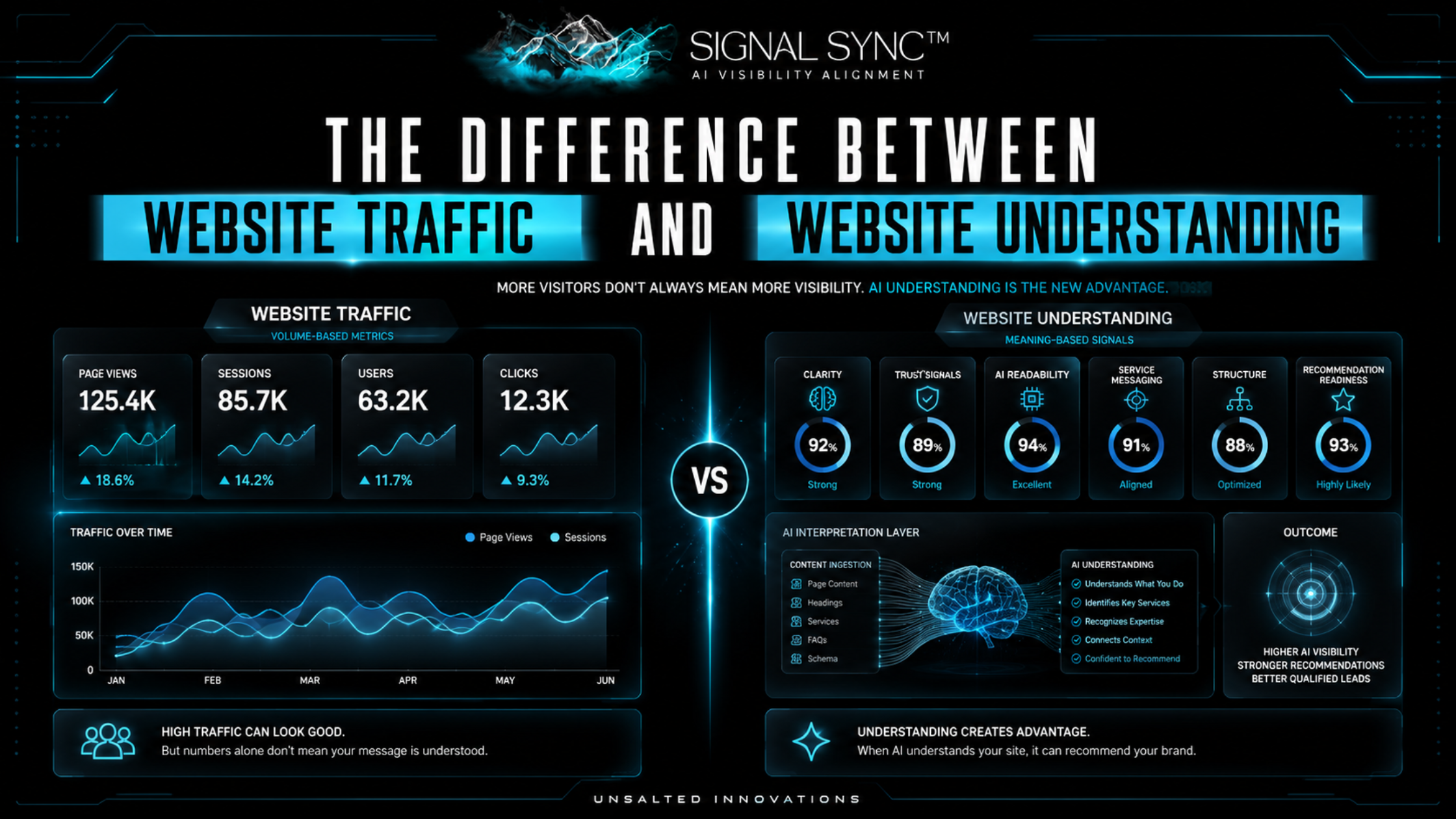
AI visibility comes down to how clearly your business is represented online.
Search engines and AI tools need enough context to understand what you do, where your expertise fits, who your services are relevant to, and whether the information they find about your business supports that understanding.
When your website, content, trust signals, and broader online presence are aligned, your business has a stronger foundation for showing up in the right search and AI-assisted discovery experiences.
For a business, the useful question is whether the information available online gives people and the systems helping them search an accurate picture of the company.
Your website gives you the most control over that picture. Depending on the platform and the search, other public information may also be part of the research, including your Google Business Profile, reviews, articles, case studies, professional listings, media coverage, videos, forums, directories, and other sources across the web.
Signal Sync™ looks at how those pieces relate to one another and whether the current version of the business is actually being represented.
The platform ultimately decides what it cites, summarizes, or recommends. My role is to strengthen the information, structure, authority, and consistency your business can control.
Google’s Guidance
Gives Us a Clearer Place to Work From
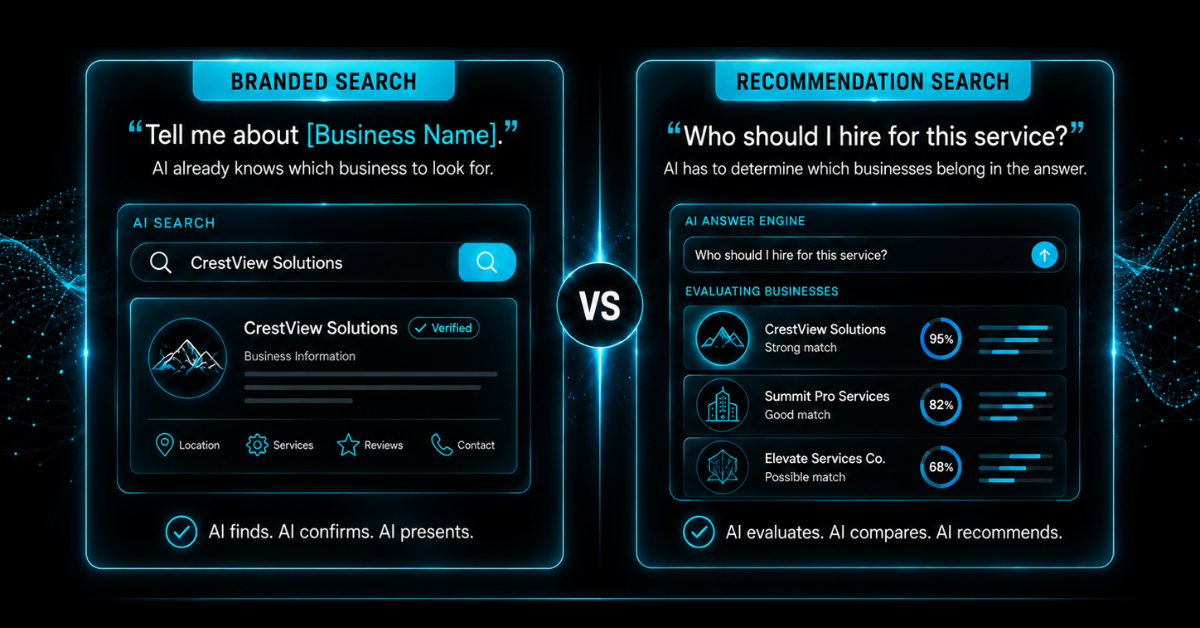
There has been no shortage of advice about how businesses should prepare for AI search. Some of it has been useful. Some of it has created another long list of tactics businesses are told they need to add.
Google’s current guidance for generative AI features in Search gives us a much clearer checkpoint. Google confirms that AI Overviews and AI Mode are rooted in its core Search ranking and quality systems, which means the fundamentals of strong SEO continue to matter.
The part of Google's guidance I pay closest attention to is its emphasis on non-commodity content.
Google describes content with long-term value as the kind that brings something genuinely useful to the web: firsthand experience, an original point of view, deeper knowledge of the subject, and information that adds to what is already available. Google says this kind of unique, useful content is likely to matter more for long-term generative Search visibility than the other recommendations in its guide.
For the businesses I work with, a lot of that information already exists.
It exists in the questions customers ask repeatedly, the patterns you have learned to recognize, the decisions you make during a project, the details you notice because you have done the work for years, the client results you can document, and the perspective you have earned through experience.
A surprising amount of that knowledge never makes it onto the website.
That is something I look for through Signal Sync™.
One Search Can Pull From
More Context Than One Keyword
Google also confirms that AI Mode can use query fan-out, where one search can lead to several related searches behind the scenes as Google gathers information for its response.
That makes the relationships between your services, expertise, customer questions, case studies, supporting content, and website pages worth paying attention to.
It does not require a separate page for every phrase someone might type. Google's systems can understand related meanings without requiring exact wording, and its current guidance specifically advises site owners to focus on useful content instead of rewriting pages around every possible long-tail variation.
Within Signal Sync™, I use that information to build useful depth around the work a business genuinely does and connect related information where the relationship is helpful to the person using the site.
Why I Created Signal Sync™
Signal Sync™ grew out of something I was already seeing in website, branding, content, and marketing projects.
I would talk with a business owner and hear a detailed explanation of their work. They understood their customers. They knew the questions people usually asked before hiring them. They could explain why they approached the work a certain way and what experience had taught them.
Then I would look at the website and find a much thinner version of the business.
An important service might be summarized in a few vague sentences. A specialty that came up constantly in conversation was missing completely. Reviews showed clear patterns of why customers trusted the company, but none of that proof had been connected to the service pages. The business had changed while older language remained scattered across other platforms.
Those gaps already affect how people understand a business.
They also affect the information available to search engines and AI-assisted search.
Signal Sync™ gives me a framework for looking at the connections between those pieces instead of treating every page, platform, and marketing channel as a separate project.
The Six Pillars of Signal Sync™
-
I start with the experience someone has when they land on the website.
Can they make sense of the services? Does the navigation reflect how the business actually works? Are important details easy to find? Have new offers been added without updating the pages around them? Does the website answer the questions someone would reasonably have before reaching out?
Website Clarity looks at the role each page plays in explaining the business and helping someone move through the site with confidence.
-
Business owners and customers do not always use the same language.
Industry terminology can become second nature to the person providing the service while the customer describes the need in an entirely different way.
I look at whether the website gives enough context around the service, problem, process, audience, and expertise for the meaning to be clear without forcing repetitive search phrases into the copy.
Google's systems are designed to understand related meanings and synonyms, so exact-match repetition is not the goal.
The language still needs to sound like the business.
-
I look at what supports the claims being made.
That may include customer reviews, credentials, professional experience, case studies, project examples, client outcomes, portfolio work, media coverage, interviews, affiliations, original research, or other evidence connected to the service.
I also look at where that proof lives.
A business may already have excellent trust signals while the pages that would benefit from them most barely acknowledge they exist.
Signal Sync™ helps connect the proof with the expertise it supports.
-
Extractability is the Signal Sync™ term I use for how easily important information can be located, understood, and used accurately.
Sometimes that means giving an important customer question a clearer answer. Sometimes a service needs enough detail to stand on its own page. Sometimes information has been buried inside a long section of copy or separated from the page where it would make the most sense.
I use headings, sections, FAQs, internal links, and page structure when they improve the experience of finding and understanding the information.
Google's current guidance specifically says artificial content “chunking” is unnecessary for generative Search and recommends organizing content around what makes sense for the human audience.
That fits the way I want Signal Sync™ implemented. Structure should make the information clearer without flattening the way the business communicates.
-
I care about this because better visibility has very little value if the business loses its identity in the process.
The strongest information often comes from the things you naturally say when you are explaining your work to a customer.
It is the answer you have given a hundred times, the detail you notice that someone outside the industry would miss, the way you walk a client through a decision, or the opinion you developed after years of seeing the same problem.
Voice Alignment helps bring more of that experience into the digital presence while keeping the language recognizable as your own.
Google's emphasis on expert-led, firsthand, non-commodity content makes that even more relevant now.
-
Once the information itself is strong, I look at the foundation supporting it.
Depending on the website, that may include crawlability and indexing, page architecture, internal linking, metadata, mobile experience, accessibility, Google Business Profile alignment, page performance, and structured data where there is a legitimate use for it.
These remain part of good SEO, and Google confirms that those foundational practices continue to support visibility in generative Search because AI Overviews and AI Mode rely on Google's Search index and ranking systems.
Structured data still has valid uses for SEO and supported rich results. Google also makes clear that there is no special schema required simply to appear in generative Search.
Your Website Gives Us the Foundation.
The Rest of Your Online Presence Helps Complete the Picture.
I begin with the website because it is where a business has the greatest control over its own information.
From there, I look at the public sources that matter for that particular business.
For a local service provider, Google Business Profile, customer reviews, local directories, professional listings, community references, or media coverage may be especially important.
For another business, the useful sources may include industry publications, interviews, case studies, videos, professional profiles, or other third-party references.
The mix will be different from one business to another.
What I am looking for is whether those pieces reinforce the current version of the business or whether someone researching the company is likely to encounter conflicting, outdated, or incomplete information.
That same consistency helps the human customer long before we start talking about AI visibility.
The Content Worth Publishing
Is Usually Connected to Real Work
A plumber knows which questions often point to a larger repair.
A REALTOR® hears the concerns buyers raise when they become serious about a particular area.
A designer can explain the decisions behind a transformation that the finished photo cannot show.
A boutique owner learns exactly where customers get confused about fit, materials, styling, or care.
A service provider begins to see patterns after helping client after client solve the same type of problem.
Those observations can become useful service-page content, case studies, FAQs, project breakdowns, articles, videos, and customer resources when there is something worthwhile to say.
This is also how I approach the use of generative AI in content creation.
In Google’s guidance on using generative AI content on a website, Google explains that generative AI can be useful for research and for adding structure to original content, while still placing the responsibility on the publisher to consider accuracy, quality, relevance, and whether the finished content adds value for the person reading it.
That is also how I believe AI should be used in business. It can help with the process while the experience, judgment, and point of view stay connected to the people who actually earned them.
Preparing Websites for AI Agents
I am also beginning to include Agent Readiness in the way I review websites.
Google now discusses AI agents that may gather information or perform tasks on behalf of a user. Browser agents can interpret a site's visual rendering, DOM structure, and accessibility tree while navigating the page.
For Signal Sync™, that reinforces website practices that already make sense for people: clearly labeled buttons, logical navigation, accessible forms, meaningful headings, understandable service information, stable interactions, and obvious next steps.
I treat Agent Readiness as part of good website usability and accessibility as this area develops.
Signal Sync™ AI Visibility Services
for Businesses Nationwide
Unsalted Innovations is based in Knoxville, Tennessee, and Signal Sync™ services are available to businesses throughout the United States.
Signal Sync™ AI Visibility Audit
The $297 Signal Sync™ AI Visibility Audit is where I recommend starting when you know something needs attention but you do not yet know where the real gaps are.
I review your website and relevant online visibility signals, identify areas that are unclear, inconsistent, outdated, unsupported, or difficult to navigate, and organize the findings by priority.
You receive a written action plan so you know what deserves attention first.
If your audit shows that a larger Signal Sync™ implementation is appropriate and you choose to move forward, the $297 audit fee is applied toward the implementation investment. That process is already reflected on your live Audit page.
Website + AI Visibility Implementation
When the website itself needs deeper work, I provide done-for-you Signal Sync™ website strategy and implementation.
The scope is based on the business and may include homepage and service-page restructuring, messaging, modern SEO, internal linking, trust signals, authority content, case studies, metadata, accessibility improvements, Google Business Profile alignment, and structured data where it serves a real purpose.
Your current Website Implementation page includes packages ranging from focused page alignment through full-site builds.
Broader Signal Sync™ Alignment
Sometimes the website is only one part of the disconnect.
Signal Sync™ also extends into brand identity and social alignment when those areas no longer reflect the same services, voice, positioning, or authority the website is communicating.
Signal Sync™ in Practice
Friendly Neighborhood Plumber | Knoxville, TN
Friendly Neighborhood Plumber came to Unsalted Innovations for a website project that involved much more than changing the visual design.
The work included clearer plumbing service pages, stronger Knoxville-area positioning, improved website organization, internal linking, trust signals, search-focused page support, and a structure that better reflected the services the company actually provided.
During the first month after implementation, Google Analytics showed:
447.27% increase in active users
145.74% increase in website views
253.19% increase in sessions
40% increase in organic search sessions
Those numbers are early website and search-performance results from the first month after launch. They are not being presented as proof that AI visibility alone caused the growth or as a promise of future placement in AI-generated results.
The case study is useful because it shows how service clarity, local context, site structure, trust, and search fundamentals can work together across one real business.
About the Creator of
Signal Sync™


I'm Brianna Sybesma, founder of Unsalted Innovations, LLC and creator of Signal Sync™ AI Visibility Alignment.
My background brings together communication, graphic design, audio and video engineering, more than a decade of technical event production and project management, website strategy, marketing, content development, and the way AI-assisted search is becoming part of everyday business discovery.
That background taught me to pay attention to how separate pieces work together.
A website, business profile, service page, review, article, social profile, and customer experience may each look fine on their own while telling a very different story when you step back and look at the whole system.
Signal Sync™ gives me a way to find those disconnects.
My approach is rooted in Humane Technology, which means using technology to support clearer communication, stronger visibility, and better customer experiences while protecting the voice, values, experience, and relationships behind the business.
I want the online version of your business to be a stronger reflection of the business you have actually built.
Written and reviewed by Brianna Sybesma
Creator of Signal Sync™ AI Visibility Alignment
Last reviewed September 2026Frequently Asked Questions About AI Visibility
-
AI visibility describes how clearly a business can be found and understood when AI-assisted search is gathering information connected to its services, products, expertise, or industry.
The information involved can vary by platform and search. Signal Sync™ focuses on strengthening the website, business information, trust, authority, content, and digital relationships a business can control.
-
For Google Search specifically, SEO remains foundational.
Google says its generative AI features are rooted in its core Search ranking and quality systems and describes optimization for generative Search as part of SEO.
Signal Sync™ takes a wider view because I also work across business clarity, trust signals, content, brand alignment, third-party information, and other parts of the online presence that affect how the business is represented beyond one search ranking.
-
Signal Sync™ is the six-pillar framework I created to review Website Clarity, AI Visibility Language, Trust Signals, Extractability, Voice Alignment, and Visibility Structure together.
It gives me a consistent way to identify where the online version of a business has become unclear, outdated, disconnected, or incomplete and determine what should be strengthened next.
-
Google says llms.txt is unnecessary for its generative Search features. Its current guidance specifically lists unnecessary AI text files such as llms.txt among tactics site owners can ignore when focusing on Google Search.
Other platforms can develop different standards, so I continue to follow those changes without treating one file as a universal AI visibility solution.
-
Google says structured data is not required for generative AI Search, and there is no special AI schema that needs to be added for AI Overviews or AI Mode.
Structured data still has legitimate uses within SEO and supported rich-result features, so I use it where it accurately supports information already visible on the website.
-
Yes.
Google's guidance says generative AI can be useful for research and helping structure original material. It also warns against generating large numbers of pages without adding value and asks site owners to focus on accuracy, quality, and relevance.
Within Signal Sync™, AI can support the process while the final content remains grounded in the business's real knowledge, voice, experience, and purpose.
-
No. Those platforms control their own results, sources, ranking systems, models, and recommendation processes.
Signal Sync™ strengthens the parts of your digital presence your business can influence: the quality and clarity of the website, accurate service information, useful original content, trust and authority signals, website structure, consistency, and the broader information available about the business.
-
Yes.
Unsalted Innovations is based in Knoxville, Tennessee, and I provide Signal Sync™ AI Visibility Audits, website strategy, implementation, and AI Visibility Alignment for businesses throughout the United States.
Start With a Clear Picture of What Is Online Today
If the business you can explain in a conversation is clearer than the business someone finds online, there is something worth looking at.
The Signal Sync™ AI Visibility Audit gives us a place to review what is currently being communicated, where useful information is missing, what already supports your authority, and which gaps deserve attention first.
You receive a prioritized action plan, and if deeper implementation makes sense, we build from there.
Your business. Your voice. Sync to the rhythm of AI.