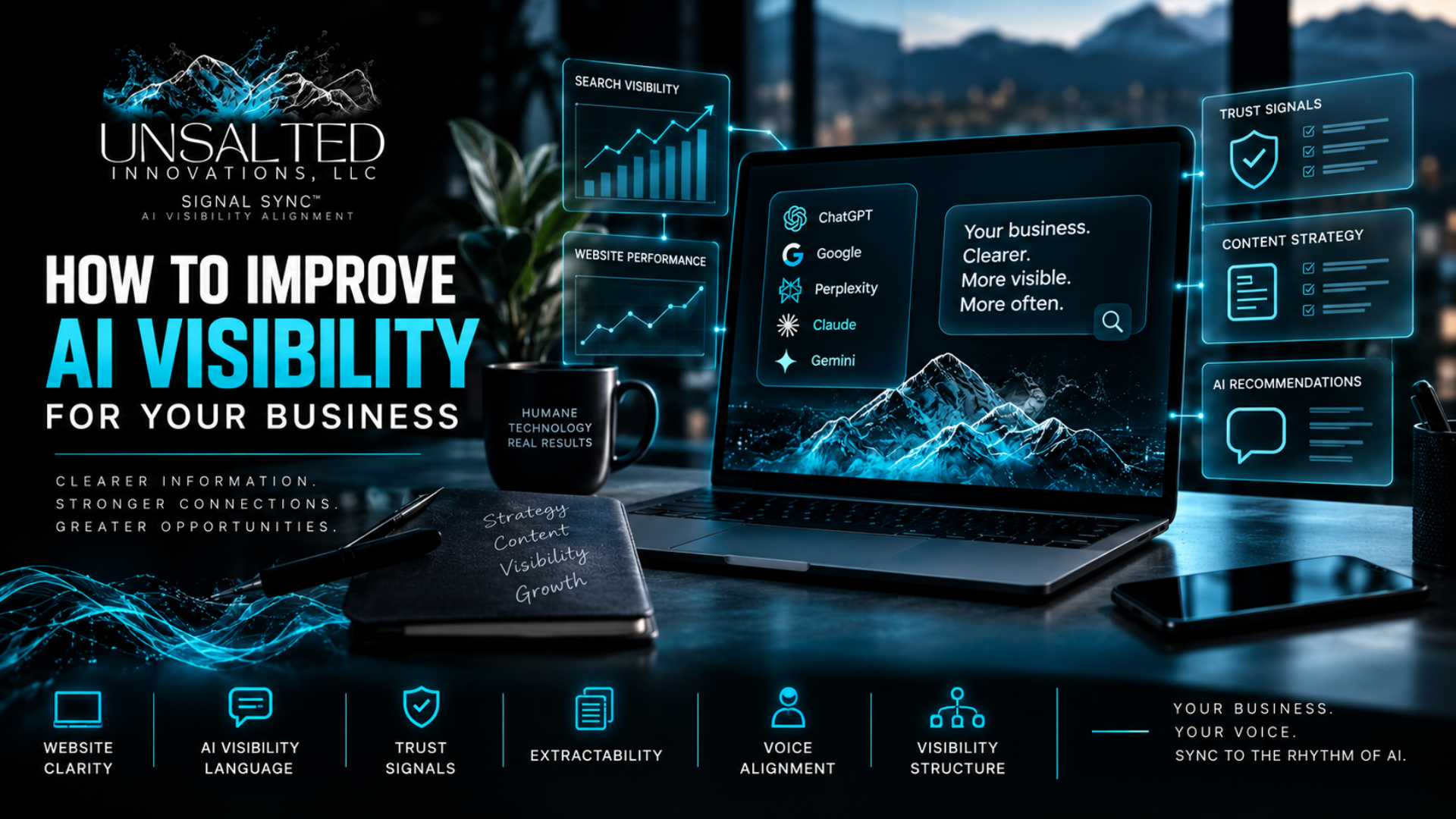
Improving AI visibility begins with the information your business already controls.
Your website.
Your service descriptions.
The experience and expertise you have documented.
The proof supporting what you say.
The technical foundation that helps search engines find your pages.
The relationships between your website, Google Business Profile, reviews, case studies, professional profiles, articles, and other public information about your company.
AI platforms ultimately decide which sources they retrieve, cite, summarize, or recommend. A business cannot control the final answer.
What we can improve is the quality, clarity, accuracy, usefulness, and consistency of the information available before that answer is created.
That is the work I organize through Signal Sync™ AI Visibility Alignment.
I use six connected pillars to look at where a business is already strong, where the online version has fallen behind the real company, and what deserves to be strengthened next.
Start With Accuracy Before Adding More Content
When someone wants better visibility, it is tempting to immediately think about what else should be added.
More blogs.
More FAQs.
More service pages.
More schema.
More profiles.
I usually want to know whether the information already online is accurate first.
Has the business changed?
Are you still offering every service listed on the website?
Have you added something important that barely appears online?
Does the service area still reflect where you work?
Does your About page describe the business you run today?
Are older descriptions still showing up on directories, social profiles, or Google Business Profile?
Are several different names being used for the same service?
Sometimes improving visibility begins with correcting, consolidating, or connecting what already exists.
Adding another layer of content before those basic facts are aligned can make the digital presence more complicated without making it clearer.
1. Make Your Important Services Easier to Understand
One of the first places I look is the service structure.
A potential customer should be able to understand what you actually provide without already knowing your industry terminology.
That does not mean every service needs an enormous page.
It does mean an important service usually needs enough context to answer reasonable questions such as:
What is the service?
What kind of situation leads someone to need it?
Who is it appropriate for?
What does the process involve?
Where is the service available?
What experience or proof supports it?
What should someone do next?
This is also where I look at whether several very different services have been compressed into one vague page.
Sometimes they belong together.
Sometimes one has become important enough to deserve its own page and supporting information.
The decision should come from the business and the usefulness of the content rather than a desire to create a URL for every possible search phrase.
Google’s current generative AI optimization guidance specifically advises publishers against creating large numbers of pages simply to target long-tail or query fan-out variations. Google instead emphasizes useful content built around the audience and subject itself.
2. Make Sure Important Pages Can Actually Be Found
For Google visibility, AI optimization still begins with Search fundamentals.
In Google’s guidance for AI features and your website, Google explains that pages supporting AI Overviews and AI Mode still need to be indexed and eligible to appear in Search. Google also says there are no additional technical requirements simply for participation in those generative Search experiences.
That means I still care about:
crawlability
indexing
internal links
canonicalization
mobile usability
page experience
meaningful page titles and metadata
accessible content
whether important information exists as usable page content
If a major service page is difficult for Google to discover or has accidentally been excluded from indexing, publishing ten more articles will not correct that underlying problem.
The technical Search foundation belongs inside AI visibility work because Google has explicitly connected its generative Search experiences to its existing Search systems.
3. Build Stronger Relationships Between Your Pages
I pay a lot of attention to internal linking.
A website often contains useful information that has never been connected.
A service page exists.
A case study proves the service works.
Three blogs answer common questions about the service.
The About page establishes the owner's experience.
Customer reviews reinforce the same specialty.
Yet each piece sits in isolation.
Internal linking helps turn those separate pieces into a more useful path through the website.
If someone is reading about a service, a relevant case study may help them evaluate it.
If they are reading an educational article, the deeper guide may answer the next question.
If they are trying to understand your methodology, the audit or implementation page may be the appropriate next step.
That is how I now structure my own AI visibility content.
My AI Visibility Overview explains Signal Sync™ and the commercial service.
My Complete AI Visibility Guide provides the deeper educational reference.
My AI Search Questions for Businesses page answers specific technical and strategy questions.
Each one has a different role, but they reinforce the same body of expertise.
Google also includes internal linking among the established SEO practices that remain relevant to its AI features.
4. Bring More of Your Firsthand Expertise Online
This may be one of the largest opportunities for established businesses.
You have probably learned things through real work that would be difficult for someone outside your industry to know.
Those details are easy to overlook because they feel ordinary to you.
You have answered the same customer question so many times that you no longer think of the answer as expertise.
You recognize a problem earlier because you have seen it repeatedly.
You know what mistakes customers make before hiring someone in your industry.
You know which details affect the outcome of a project.
You have developed opinions because experience taught you what works.
That knowledge can improve AI visibility when it becomes useful information people can actually find.
It may belong on a service page.
It may become a case study.
It may answer an FAQ.
It may deserve an article of its own.
It may become a video, resource, comparison, process explanation, or project breakdown.
Google's current generative Search guidance places significant emphasis on unique, useful, non-commodity content rooted in firsthand knowledge, deeper expertise, and original perspective. That direction is also consistent with Google's broader guidance around helpful, reliable, people-first content.
For me, that is a much stronger content strategy than publishing another generic article simply because a keyword tool says the topic exists.
5. Use AI to Support Your Expertise Without Replacing Its Source
I use AI in my own work.
It can help organize information, research a subject, find gaps in a draft, compare structure, brainstorm questions, and turn a large amount of information into something easier to work through.
The source of the expertise still matters.
In Google’s guidance on using generative AI content, Google says generative AI can be useful for research and adding structure to original content. It also warns that generating large numbers of pages without adding value may violate its scaled-content policies and tells publishers to focus on accuracy, quality, and relevance.
That fits the way I approach Humane Technology.
AI can help with the process.
The real client experience, professional judgment, stories, observations, opinions, results, and expertise should still come from the people who earned them.
If AI could produce essentially the same article for every competitor in your industry, I would want to find out what information is still missing from the human side of the piece.
6. Connect Trust Signals to the Claims They Support
Trust signals become more useful when they have context.
A business may have hundreds of excellent Google reviews.
That is valuable.
I also want to know what those reviews repeatedly reveal.
Do customers keep mentioning responsiveness?
Knowledge?
Attention to detail?
A particular specialty?
A complicated problem the company solved?
Do you have a case study showing how a project unfolded?
Do credentials support a particular area of expertise?
Has the founder been interviewed about the subject?
Is there documented client work connected to the service being promoted?
The goal is to help the website show evidence around the experience and expertise already being claimed.
A service page saying “we're experts” tells someone very little.
A service page connected to real work, relevant customer proof, experience, examples, and useful knowledge gives them more to evaluate.
Those relationships also give search and AI-assisted systems more public context around the business.
7. Publish Content Around Real Customer Questions
A useful content strategy often begins much closer to the customer than a keyword spreadsheet.
What did someone ask you this week?
What did you have to explain before they understood which service they actually needed?
What almost caused a customer to make the wrong decision?
What question comes up right before someone books?
What question comes up after the project begins?
What misconception do you keep correcting?
What do people compare before choosing someone like you?
Those questions can reveal content opportunities because they reflect real information needs.
This does not mean every customer question deserves a standalone article.
Sometimes the right place is the service page.
Sometimes it belongs in a short FAQ.
Sometimes several related questions can become one substantial resource.
Sometimes the subject is large enough to deserve a dedicated article.
I look at where the answer would be most useful before deciding what format to create.
That is also why I do not treat Google's query fan-out documentation as an instruction to manufacture pages around every possible wording of a question.
The useful opportunity is depth around the real subject.
8. Strengthen the Information Outside Your Website Too
Your website gives you the greatest control over your own information.
It is still only one part of the public picture.
Depending on the business, other relevant sources may include:
Google Business Profile
customer reviews
professional directories
local directories
social profiles
media coverage
interviews
industry associations
professional profiles
videos
podcasts
case studies
third-party articles
community organizations
I look at whether those sources reinforce the current version of the business.
The wording does not need to be identical everywhere.
The important facts should make sense together.
If your website says you serve clients nationwide while five older profiles describe you as serving one region, that is worth correcting.
If one profile uses a service name you abandoned two years ago, that is worth reviewing.
For local businesses, Google specifically recommends keeping Business Profile information current as part of its guidance for Search and AI features.
Consistency is useful because the person researching you may encounter several of those sources before ever contacting you.
9. Use Structured Data Where It Accurately Describes the Page
Structured data can be valuable.
I use it when there is a legitimate reason to use it.
In Google’s introduction to structured data, Google explains that structured data provides explicit clues about the meaning of a page and can make eligible content available for supported Search features.
That may include appropriate Organization, Person, Service, Article, Product, Event, or other supported information depending on what is actually present.
Accuracy matters more to me than adding every possible property.
Google also makes clear that businesses do not need special AI schema simply to participate in AI Overviews or AI Mode. Its generative AI optimization guidance says structured data is not an additional requirement for those experiences.
Schema belongs inside the Search foundation.
I do not treat it as a shortcut to becoming an AI recommendation.
10. Protect the Voice of the Business While Improving Clarity
One of my six Signal Sync™ pillars is Voice Alignment because clearer information should still sound like the company behind it.
I do not want every website to end up sounding like it went through the same optimization machine.
The phrases you use with customers matter.
The stories you tell matter.
The way you explain your process matters.
The values influencing your decisions matter.
Your point of view matters.
Your professional vocabulary may need additional context for a customer, but it does not need to be removed simply because a search system is involved.
This is where my Humane Technology philosophy becomes practical.
Technology should help us communicate the business more clearly.
It should not erase the people who made the business worth finding.
11. Test More Than Your Business Name
Branded searches are useful.
If I ask:
“What does Unsalted Innovations do?”
I am testing whether the system can identify a company I have already named.
That is different from asking:
“Who can help my business improve its AI visibility?”
Now the system has to determine which businesses may be relevant.
Those non-branded or recommendation-style searches are especially useful when I am trying to understand whether the company is being associated with the expertise it wants to become known for.
I may test:
the primary service
a customer problem
a specialty
a geographic need
a comparison
a recommendation request
a question connected to the company's expertise
I am looking for patterns rather than treating one response as a permanent ranking.
Different platforms and different queries can produce different results.
If your business is not appearing where you expect, I explain the diagnostic side in Why Your Business Isn’t Showing Up in AI Search.
12. Measure More Than AI Mentions
AI visibility should not become another vanity metric.
I want to know whether the larger digital presence is becoming stronger too.
Depending on the project, I may look at:
organic search traffic
impressions
clicks
indexed pages
important landing-page performance
engagement
inquiries
booking actions
calls
branded search
non-branded search
AI referral traffic where identifiable
AI visibility observations
local visibility
conversions
A business can improve its website significantly without immediately appearing in every AI recommendation query.
A mention can also appear without producing a meaningful business result.
The larger goal is to create a stronger digital foundation for discovery, understanding, trust, and conversion.
Improving AI Visibility Does Not Always Require a New Website
This is important.
Sometimes I audit a site and find that the design itself is perfectly workable.
The stronger opportunity may be clearer service content, internal linking, improved metadata, trust signals, content, technical corrections, or better connections between existing pages.
Another website may have structural limitations that make meaningful improvement difficult without deeper rebuilding.
I do not want to decide that before looking.
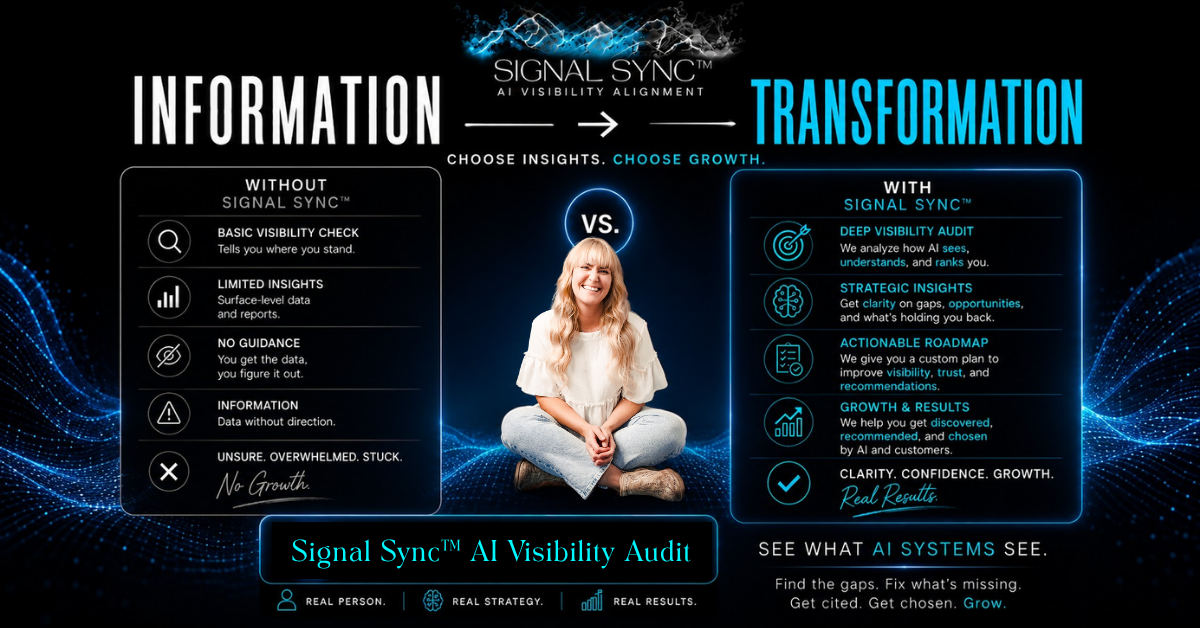
That is one reason I begin most Signal Sync™ work with the Signal Sync™ AI Visibility Audit.
The audit gives me a chance to see what is actually happening before recommending the level of implementation.
If you want to understand what I review during that process, my AI Visibility Audit: What Should Actually Be Reviewed? article walks through the audit methodology in more detail.
What AI Visibility Improvement Looked Like for Friendly Neighborhood Plumber
Friendly Neighborhood Plumber already had the real-world expertise.
The website needed a stronger way to communicate it.
The Signal Sync™ implementation included clearer plumbing service pages, stronger Knoxville-area context, better website organization, internal linking, trust signals, and search-focused support.
During the first month after implementation, Google Analytics showed a 447.27% increase in active users, 145.74% increase in website views, 253.19% increase in sessions, and a 40% increase in organic search sessions compared with the previous period. Your current live Signal Sync™ authority page correctly identifies these as early website and search-performance results rather than proof that AI placement caused the growth.
The Friendly Neighborhood Plumber Signal Sync™ case study shows how those changes worked together across one business.
That distinction matters to me.
AI visibility improvement should still produce a better website and a clearer customer experience even when we cannot control what an independent AI platform chooses to recommend tomorrow.
What Should You Improve First?
There is no universal first change.
If important pages are not being indexed, I would address that before publishing a large new content cluster.
If the technical foundation is healthy but the services are barely explained, clearer service information may be more important.
If the website is strong while outdated information is scattered across the rest of the web, alignment may deserve attention.
If the business has years of expertise but almost no original authority content, that may be the opportunity.
If customer proof is strong but disconnected from the services it supports, I may begin there.
This is the difference between improvement and random optimization.
The right next step depends on the gap.
My Complete AI Visibility Guide explains the larger Signal Sync™ framework behind these decisions, while my AI Search Questions for Businesses resource answers specific questions about SEO, AEO, GEO, schema, llms.txt, query fan-out, AI-generated content, measurement, and related topics.
About the Author
I'm Brianna Sybesma, founder of Unsalted Innovations, LLC and creator of Signal Sync™ AI Visibility Alignment.
My work brings together website strategy, marketing, modern SEO, content development, brand clarity, technical systems, and AI-assisted search.
Signal Sync™ grew from something I kept encountering in real client work: the business I heard someone explain in conversation was often much clearer, more experienced, and more interesting than the version I could find online.
I created the framework to help close that gap across Website Clarity, AI Visibility Language, Trust Signals, Extractability, Voice Alignment, and Visibility Structure.
My approach is rooted in Humane Technology, which means using technology to support clearer communication and stronger visibility while protecting the voice, experience, values, and relationships behind the business.
Unsalted Innovations is based in Knoxville, Tennessee, and I work with businesses throughout the United States.
Learn more about Brianna Sybesma and Unsalted Innovations.
Written and reviewed by Brianna Sybesma
Creator of Signal Sync™ AI Visibility Alignment
Updated September 2026
Improve the Right Things First
If you know your business has more expertise, proof, and useful information than your current online presence communicates, there is probably something worth strengthening.
You do not need to guess which AI tactic to try next.
The $297 Signal Sync™ AI Visibility Audit gives me a place to review your website and supporting online presence, identify the gaps that deserve attention, and organize what should happen next by priority.
If the findings show that the website needs deeper work, I also provide Signal Sync™ Website + AI Visibility Implementation for businesses throughout the United States.
Your business. Your voice. Sync to the rhythm of AI.