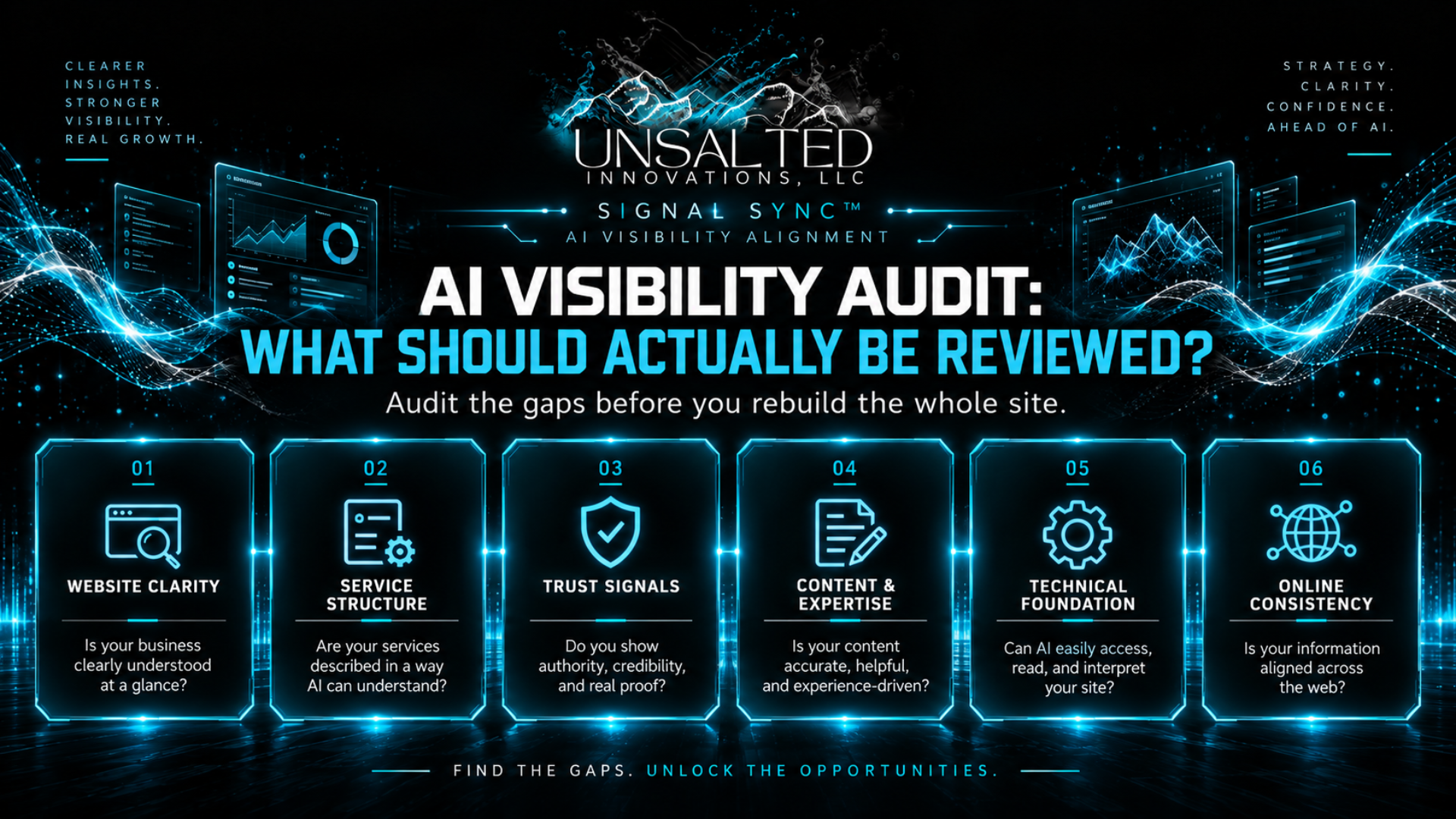
An AI visibility audit should do more than type a business name into ChatGPT, take a few screenshots, and assign a visibility score.
Those tests can give us useful information, but they do not explain the whole problem.
If a business is being overlooked, misunderstood, or inconsistently represented in AI-assisted search, I want to know what information exists underneath that result.
I want to see what the website actually communicates, whether the important pages can be found, how the services are organized, what expertise has been documented, where trust is being established, whether business information is consistent, and what outside sources reinforce or contradict what the company says about itself.
That is the kind of review I built into Signal Sync™ AI Visibility Alignment.
An audit gives us a diagnosis before we decide what needs to be rewritten, restructured, added, removed, or left alone.
What Is an AI Visibility Audit?
An AI visibility audit is a strategic review of the information and digital signals that help represent a business across search and AI-assisted discovery.
The exact scope can vary depending on the company.
A local service business may need close attention to Google Business Profile, service areas, local reviews, directories, and individual service pages.
A consultant serving clients throughout the United States may need stronger authority around an area of expertise, clearer nationwide positioning, more original thought leadership, and better connections between educational content and commercial services.
An ecommerce company introduces another set of considerations around products, categories, merchant information, reviews, and structured data.
I do not think every business should receive the same checklist with a different logo placed on the report.
The point of the audit is to determine what is happening in this particular digital presence.
If you are still trying to understand what the role itself involves, I explain that more fully in What Does an AI Visibility Consultant Actually Do?
An AI Visibility Score Is a Starting Point, Not the Diagnosis
Scores can be helpful.
They give us a way to organize observations, identify areas that deserve attention, and make a complicated digital presence easier to evaluate.
I use visibility scoring myself.
What matters is understanding what sits behind the number.
A score does not automatically tell you why a service is difficult to find, why a company is being described incorrectly, why another provider appears more consistently in non-branded searches, or which website change should happen first.
That distinction matters even more when companies promote proprietary “AI ranking scores.”
Google specifically warns businesses to be cautious with third-party tools that promise ranking success or claim access to internal Google metrics because no third-party tool has access to Google's internal ranking or AI systems.
An audit can absolutely use outside tools and AI platforms as part of the research.
I do.
I simply separate what I can actually observe from what a third-party platform is estimating.
What Should an AI Visibility Audit Actually Review?
When I conduct an audit, I am trying to understand how the different parts of the business's online presence work together.
There are several areas I want to see before deciding what the business needs.
1. The Business as It Exists Today
Before I evaluate the website, I need to understand the business behind it.
What services are actually being offered?
Which services matter most?
Has the company added a specialty?
Has its ideal customer changed?
Is it local, regional, nationwide, or a combination?
What does the owner want the business to become known for?
This sounds basic until I compare those answers with what is online.
I frequently find that the business has moved forward while pieces of its digital presence are still describing an earlier version of the company.
That can affect everything that follows.
2. Website Clarity
Then I look at whether the website communicates the business clearly enough for someone encountering it for the first time.
That includes the homepage, About page, service pages, navigation, calls to action, geographic information, and the relationships between the pages.
I look for vague descriptions that could apply to almost any competitor.
I look for important services receiving only a sentence or two.
I look for language that assumes the visitor already understands the industry.
I also look for the opposite problem: a large amount of content that still leaves someone unsure what the company actually does.
Clarity is one of the six pillars of Signal Sync™ because almost every other visibility decision becomes harder when the business itself has not been explained well.
3. Service Page Structure
A service needs enough context to be understood as a meaningful part of the business.
Sometimes that can happen within one well-developed services page.
Other times, an important service deserves its own page because there are distinct customer questions, processes, expertise, proof, or supporting information around it.
I do not create separate pages simply to capture every possible keyword or question.
Google’s current generative AI optimization guidance specifically cautions against creating large numbers of pages primarily to target variations of searches or fan-out queries. Google continues to recommend useful, original content built around the needs of the audience.
The audit helps me decide where additional depth would genuinely improve the website and where it would simply create more content.
4. Crawling, Indexing, and the Technical Search Foundation
For Google visibility, the technical foundation still matters.
Google says that a page must be indexed and eligible to appear in Search with a snippet before it can be eligible to appear as a supporting link in AI Overviews or AI Mode. It also says there are no additional technical requirements specifically for those AI features.
That means an AI visibility audit should still ask questions such as:
Can Google access the important pages?
Are those pages indexed?
Has anything important been unintentionally blocked?
Are internal links helping important pages get discovered?
Does the site have unnecessary duplicate pages?
Is important information available as actual text?
Does the website function properly across devices?
This is why Google’s guidance for AI features and your website remains one of the sources I use when separating established Search requirements from emerging AI optimization theories.
5. Internal Linking and Page Relationships
I pay close attention to how information is connected.
A strong service page may have a case study sitting elsewhere on the site that never links back to it.
An educational article may explain a problem beautifully without giving the reader a path to the relevant service.
The About page may establish years of professional experience while none of the site's authoritative content connects that expertise to the author.
A group of articles may all cover related topics but exist as isolated posts.
Internal links help people continue through the website naturally, and Google specifically includes making content findable through internal links among its existing SEO recommendations for AI features.
The goal is not to create links everywhere.
The goal is to connect information where the relationship actually helps someone.
You can see that structure on this site through the relationship between my AI Visibility Overview, Complete AI Visibility Guide, and AI Search Questions for Businesses.
Each page has a different purpose, but they support the same larger subject.
6. AI Visibility Language
I also look at how the business describes its services compared with how customers describe their needs.
People do not always know the formal name of the service they are trying to find.
Someone may search for the problem first.
They may ask for a recommendation.
They may describe a situation.
They may compare several kinds of providers.
That does not mean a website needs to repeat every imaginable long-tail phrase.
Google specifically says its AI systems can understand synonyms and general meanings and that publishers do not need to rewrite content around every possible search variation.
I am looking for enough natural context around the service that the meaning remains clear even when someone approaches it from a different question.
7. Firsthand Expertise and Original Content
This has become one of the areas I spend more time thinking about.
Many businesses already have years of useful knowledge that never became part of the website.
I want to know:
What questions keep coming up with customers?
What patterns has the owner noticed?
What decisions happen behind the scenes?
What lessons came from actual projects?
What does this business understand after years of doing the work that someone new to the industry probably would not?
That information can become service-page depth, articles, case studies, project explanations, FAQs, videos, educational resources, or supporting content.
Google’s current generative AI guidance places significant emphasis on unique, expert-led, non-commodity content and encourages site owners to bring firsthand knowledge and original perspective to the web. Its broader guidance around helpful, reliable, people-first content reinforces that same direction.
I would rather uncover three genuinely useful ideas from someone's experience than recommend thirty generic articles simply because competitors have them.
8. Trust Signals and Supporting Evidence
Then I look at what supports the business's claims.
That can include:
customer reviews
testimonials
case studies
project results
credentials
years of professional experience
portfolio work
professional profiles
awards or affiliations
media coverage
interviews
community involvement
original research or documented expertise
The point is not to collect badges.
I want the evidence to make sense in context.
If a business says it specializes in a particular service, does the online presence contain anything that helps support that expertise?
If reviews repeatedly mention the same strength, is that useful insight represented anywhere on the website?
If a business has achieved meaningful results for clients, has it documented how the work was approached?
A trust signal becomes much stronger when it supports something specific.
9. Business Information Beyond the Website
The website is a major authority asset, but it is not the only place the business exists.
Depending on the company, I may also look at:
Google Business Profile, social profiles, important directories, professional listings, review platforms, media coverage, interviews, industry profiles, and other relevant public references.
I am looking for alignment.
Does the service description match?
Is the location accurate?
Is an old offer still being promoted somewhere?
Does one profile describe the business completely differently from the website?
Has the company expanded nationally while older profiles still make it appear local?
For local businesses specifically, Google recommends keeping Business Profile information current as part of its guidance for visibility in Search and its AI features.
I do not expect every sentence across the internet to be identical.
I do want the important facts to tell the same story.
10. Structured Data
Schema belongs in an audit when there is a legitimate reason to evaluate it.
I check whether existing structured data accurately represents the visible content and whether a supported structured-data type would be appropriate for the page.
I do not add schema simply because Schema.org gives us hundreds of properties to choose from.
Google’s introduction to structured data explains that structured data provides explicit clues about a page and can make eligible pages available for supported Search experiences.
Google also makes an important distinction for generative Search: structured data is not required for generative AI search, and there is no special schema.org markup businesses need to add simply for AI Overviews or AI Mode.
Schema can support the Search foundation.
It should not be sold as a secret way into an AI answer.
Should an AI Visibility Audit Include ChatGPT, Gemini, Perplexity, and Other AI Searches?
Yes, I believe AI search testing is useful.
I just do not think it should be the entire audit.
I look at both branded and non-branded searches.
A branded search asks about the business by name.
A non-branded search asks for the type of company, service, expertise, or solution without giving the system the answer in advance.
For example:
Branded:
“What does Unsalted Innovations do?”
Non-branded:
“Who can help my business improve its AI visibility?”
The second question tells me much more about recommendation visibility.
I may test different services, customer problems, geographic contexts, and platforms to look for patterns.
I am also paying attention to the sources being surfaced and whether descriptions of the business are accurate.
One missing result is an observation.
Repeated patterns across several relevant searches give me more to investigate.
If your business is struggling with this specifically, I explain the possible causes in Why Your Business Isn’t Showing Up in AI Search.
Is an AI Visibility Audit the Same as an SEO Audit?
There is meaningful overlap, especially when Google is part of the visibility strategy.
Google's position here is unusually clear.
From Google's perspective, optimizing for generative Search is still SEO because AI Overviews and AI Mode are rooted in its core Search ranking and quality systems. Google specifically cautions businesses evaluating AEO or GEO services to compare third-party recommendations against established Search guidance.
That is why my audits still include crawlability, indexing, internal links, content quality, page experience, technical structure, and other established Search considerations.
Signal Sync™ takes the review further because a business is represented by more than its organic Google rankings.
I am also interested in business clarity, customer language, reviews, authority, third-party information, voice, service positioning, and the relationships between the website and the broader digital presence.
Modern SEO remains part of the foundation.
The broader question I am trying to answer is whether the digital presence accurately represents enough of the real business to support stronger discovery and consideration.
Should an AI Visibility Audit Check llms.txt?
It can check whether one exists.
I would not make that a major audit finding for Google.
Google explicitly says it does not use llms.txt files for Search and that adding one neither helps nor harms Google Search rankings or visibility. Google also says businesses do not need new AI-specific text files, special markup, artificial content chunking, or a separate writing style simply to appear in its generative Search features.
Other systems may develop different standards over time, so I continue watching emerging technology.
The audit needs to distinguish those emerging considerations from things we already know matter.
An Audit Should Establish a Measurement Baseline
I want to know what is happening before implementation starts.
Depending on the business and available data, that may include Search Console, Google Analytics, indexed pages, organic search performance, important landing pages, conversions, local visibility, branded and non-branded observations, and current AI search testing.
Google now provides a Generative AI performance report in Search Console for eligible Search generative AI experiences, which gives website owners another first-party source of information about how content is being discovered through those features.
Measurement still needs context.
Traffic can change for many reasons.
AI responses can change.
Search demand can change.
A website redesign can affect several channels at once.
The purpose of the baseline is to give us something real to compare against later rather than trying to reconstruct the starting point after implementation has already happened.
Agent Readiness Is Becoming Another Layer Worth Watching
There is another part of visibility I am beginning to evaluate separately: Agent Readiness.
AI agents can interact with websites differently from a person using a traditional search result.
Google's current guidance notes that browser agents may inspect visual renderings, DOM structure, and accessibility information while completing tasks on someone's behalf.
I am not treating Agent Readiness as another ranking trick.
I am looking at practical website questions.
Are buttons descriptive?
Are forms labeled clearly?
Does the navigation make sense?
Are important actions easy to identify?
Does the page have a logical heading structure?
Can someone understand what happens after clicking a button?
Does the website depend on confusing interactions that make basic information harder to access?
Those improvements are useful for humans too, which is where I want the work to begin.
What Should You Receive After an AI Visibility Audit?
An audit should leave you with more clarity than you had before it started.
I want a business owner to understand:
what I found, why it matters, which findings deserve attention first, what can wait, what can be handled internally, and where deeper implementation may be worthwhile.
That is why I prioritize findings.
A 70-page report containing every possible technical observation can look impressive while still leaving someone with no idea what to do Monday morning.
The purpose of an audit is to create direction.
Red Flags I Would Question Before Paying for an AI Visibility Audit
I would ask more questions if an audit is primarily selling:
guaranteed placement in ChatGPT, Google AI Mode, Gemini, Perplexity, or another independent platform
a proprietary score presented as though it comes directly from an AI platform's internal ranking system
llms.txt as the main solution for Google AI visibility
special “AI schema” presented as a requirement for Google AI Overviews or AI Mode
hundreds of generated pages targeting every possible question variation
manufactured mentions or links solely to create artificial authority
screenshots of AI prompts without reviewing the underlying website
a generic automated report with no review of the actual business
recommendations with no explanation of why they matter
a long list of problems with no prioritization
Tools can absolutely make an audit more efficient.
I use technology throughout my own research.
The strategic value comes from interpreting what the information means for the business in front of me.
Why I Start Signal Sync™ With the Audit
Signal Sync™ implementation can touch a lot of areas.
A website may need a homepage adjustment.
It may need completely new service pages.
The current pages may be strong while the internal structure is weak.
The business may need case studies.
Older content may need to be updated.
Trust signals may exist but need to be connected properly.
A technical issue may need to be addressed before any content work makes sense.
I do not want to recommend a full website rebuild simply because I sell website implementation.
The Signal Sync™ AI Visibility Audit gives me a chance to see what the business actually needs first.
The $297 audit includes a strategic review, consultation, written action plan, and recommendations organized around the gaps I find.
If deeper website support makes sense afterward, the audit can move into Signal Sync™ Website + AI Visibility Implementation.
What Happens When an Audit Leads to Implementation?
An audit tells us where the problems are.
Implementation is where those findings become actual changes.
That could include restructuring service pages, improving homepage clarity, developing authority content, updating metadata, strengthening internal links, adding legitimate structured data, connecting reviews or case studies to the right services, correcting inconsistent information, or rebuilding sections of the website when the existing structure is holding the business back.
A good example is my work with Friendly Neighborhood Plumber.
The business already had real expertise and customer experience. The implementation focused on helping the website represent that more clearly through service structure, local positioning, internal links, trust signals, and a stronger visibility foundation.
You can see how those pieces came together in the Friendly Neighborhood Plumber Signal Sync™ case study.
Do You Need an AI Visibility Audit?
You may be ready for one if you know your digital presence does not fully reflect the business anymore and you are having trouble identifying the reason.
Maybe your website looks fine but your visibility is inconsistent.
Maybe your business has grown into new services.
Maybe you have years of expertise that barely appears online.
Maybe AI platforms understand one part of the company and completely miss another.
Maybe you have received conflicting advice about SEO, AEO, GEO, schema, llms.txt, content, or AI optimization and want someone to determine what actually applies to your business.
You do not need to know what is wrong before booking the audit.
Finding that out is the point.
About the Author

I'm Brianna Sybesma, founder of Unsalted Innovations, LLC and creator of Signal Sync™ AI Visibility Alignment.
My work brings together website strategy, marketing, modern SEO, content development, brand clarity, technical systems, and AI-assisted search.
Signal Sync™ grew from patterns I kept finding while working directly with businesses. The companies often had far more experience, customer proof, useful knowledge, and clarity than their digital presence communicated.
I created the framework to give me a structured way to find those gaps without separating the technology from the people behind the business.
That is also where my approach to Humane Technology comes in. I want businesses to become easier to find and understand without optimizing away the voice, experience, values, and relationships that made them worth finding in the first place.
Unsalted Innovations is based in Knoxville, Tennessee, and I work with businesses throughout the United States.
Learn more about Brianna Sybesma and Unsalted Innovations.
Written and reviewed by Brianna Sybesma
Creator of Signal Sync™ AI Visibility Alignment
Last reviewed September 2026
Start With the Gaps Before You Start Changing Everything
If you are unsure why your business is being missed, misunderstood, or inconsistently represented online, you do not need to rebuild everything before you know what the problem is.
The $297 Signal Sync™ AI Visibility Audit gives us a place to look at your website and supporting online presence together, identify the gaps that deserve attention, and organize the next steps by priority.
If the audit shows that deeper website work is needed, I can also take those findings into implementation.
Your business. Your voice. Sync to the rhythm of AI.