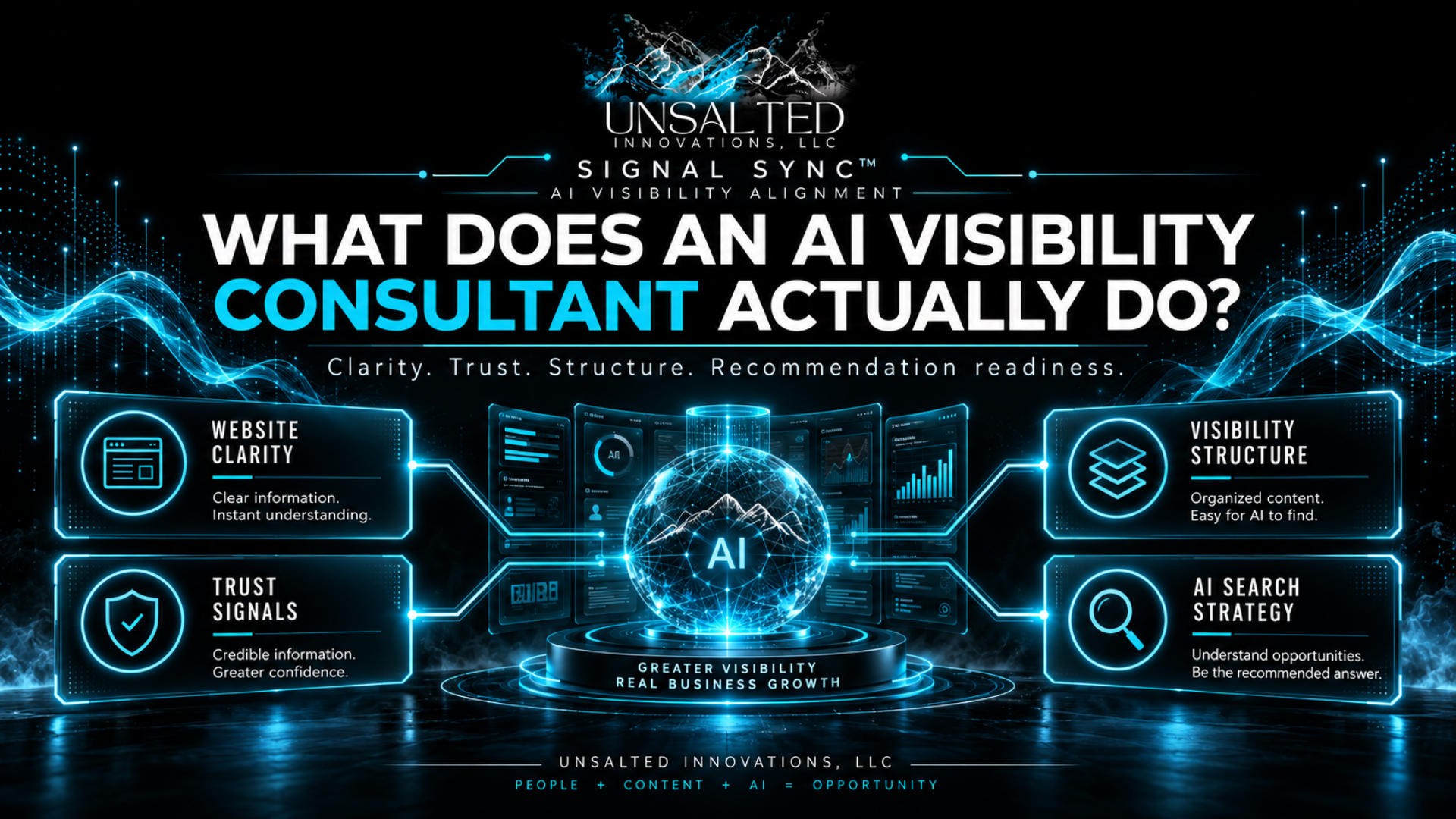
An AI visibility consultant looks at how a business is represented across the places people, search engines, and AI systems may use to understand it, then identifies the gaps making that picture incomplete, inconsistent, outdated, or difficult to verify.
In my own client work, I start with the business as it exists today and compare that with what someone can actually find online.
I want to know whether the website clearly reflects the services being offered now. I look at the questions customers repeatedly ask, the reviews that show why people trust the business, the experience that has never made it onto a service page, and the other places online where older or conflicting information may still be showing up.
From there, I can determine whether the business needs clearer website messaging, stronger service pages, modern SEO work, better internal connections, more useful authority content, stronger trust signals, technical corrections, or better alignment across the broader online presence.
That is the work I organize through Signal Sync™ AI Visibility Alignment, the six-pillar framework I created at Unsalted Innovations.
AI Visibility Consulting Starts With What Is Already Online
One of the patterns I keep finding is that businesses usually know far more than their websites show.
A business owner can spend twenty minutes explaining a service to me and answer questions with a level of detail that immediately shows years of experience.
Then I open the website and find two sentences describing the same service.
The customer reviews may repeatedly mention something the company is especially good at, but that strength is never discussed on the service page. A new specialty may have become an important part of the business while older descriptions are still sitting in directories or social profiles. The owner may answer the same valuable customer question every week without realizing that answer could become some of the most useful information on the website.
Those are visibility gaps.
Before I recommend another blog, new schema, or a technical fix, I want to understand where the information is already strong and where the online version of the business has stopped keeping up with the real one.
That approach is at the center of Signal Sync™ AI Visibility Alignment.
What Does an AI Visibility Consultant Review?
The exact review should depend on the business.
A local plumbing company does not have the same visibility needs as a consultant serving clients nationwide. A boutique has different authority signals than a medical practice. An established business with hundreds of reviews needs something different from a newer company still building its public footprint.
My Signal Sync™ framework gives me six areas to work through while still allowing the strategy to fit the individual business.
Website Clarity
I look at whether someone can understand the business from the website they actually have today.
That includes the homepage, services, navigation, location or service area, calls to action, page relationships, and the information a potential customer needs before deciding whether to reach out.
I also look for places where the business has grown faster than the website.
A new service may have been added without updating the homepage. Three offers may have been placed on one vague service page. Important information may live only on social media because nobody thought to bring it back to the website.
Website Clarity gives me the starting point.
AI Visibility Language
Customers do not always describe a problem using the same words a business uses internally.
I look at whether the language on the site gives enough natural context around the service, customer need, process, expertise, and location for the meaning to be clear.
This is where I pay attention to the way people actually ask questions without turning the page into a collection of keyword variations.
Google's current generative Search guidance confirms that its systems can understand related meanings and synonyms without requiring every possible version of a search phrase.
Trust Signals
Then I look at the evidence supporting what the business says about itself.
That may include reviews, case studies, client outcomes, professional experience, credentials, portfolio work, media coverage, interviews, affiliations, community involvement, original research, or real project examples.
Sometimes the trust is already there and simply has not been connected to the right service.
A customer should not have to search five different platforms to discover why a business is credible.
Extractability
Extractability is the Signal Sync™ term I use for how easily important information can be located, understood, and used accurately.
Sometimes the improvement is as simple as answering an important question where someone would naturally expect to find it.
Sometimes a service deserves its own page.
Sometimes useful information is buried inside a long paragraph or disconnected from the page where it would provide the most context.
I use headings, FAQs, internal links, page structure, and clearer organization when they make the information easier for the person using the website.
Google specifically says businesses do not need to artificially break content into small “chunks” for its generative Search features.
Voice Alignment
This is one of the areas I care about most.
A business can become technically clearer and still lose something important if every page starts sounding like the same SEO writer or AI model.
I pay attention to the way the owner naturally explains the work, the observations that come from experience, the questions customers bring up, the values that shape the service, and the perspective someone has earned after doing the work for years.
Those details help make the business recognizable.
They also contribute to the kind of original, firsthand information Google increasingly asks publishers to bring to the web through its guidance around helpful, reliable, people-first content.
Visibility Structure
Then I look underneath the content.
Depending on the site, that may include crawlability, indexing, page architecture, internal linking, metadata, sitemaps, robots directives, mobile usability, accessibility, Google Business Profile alignment, page performance, and structured data where it serves a legitimate purpose.
Google has been very clear that foundational SEO practices continue to support its generative Search experiences. AI Overviews and AI Mode still depend on Google's Search systems, so a technical Search foundation remains part of the work.
My Complete AI Visibility Guide goes much deeper into each of these areas and the research behind them.
Where Does SEO Fit Into AI Visibility Consulting?
SEO is still part of the foundation.
When I am working specifically with Google visibility, I do not treat AI search as though it operates independently from the Search systems underneath it.
In Google's current guidance for generative AI features in Search, Google explains that AI Overviews and AI Mode rely on its core Search ranking and quality systems. It recommends established SEO practices and explicitly says there are no additional technical requirements simply to participate in those generative Search experiences.
That means I still care whether Google can crawl and index an important service page.
I still care about internal links.
I still care whether a page has enough useful information to deserve to exist.
I still care whether the website works well on mobile and whether the metadata accurately represents the page.
Signal Sync™ expands the review because the business itself may also be represented through customer reviews, Google Business Profile, case studies, articles, professional profiles, social content, third-party websites, and other public information.
SEO and AI visibility belong in the same strategy for me. They simply give me different ways to look at how the business is being found and understood.
Some of the Best AI Visibility Work Starts With Information the Business Already Has
I do not think every visibility problem needs another content calendar.
Sometimes the useful content is sitting inside the work people are already doing.
A plumber knows which homeowner question usually signals that a small problem may be turning into a larger repair.
A REALTOR® knows which questions buyers start asking when they become serious about a particular neighborhood.
A designer can explain why one layout works better than another and what she noticed the moment she walked into the room.
A boutique owner learns exactly where customers become confused about sizing, materials, fit, styling, or care.
A consultant begins to recognize patterns after helping client after client work through the same problem.
That knowledge can become better service pages, case studies, customer resources, FAQs, project explanations, articles, or videos when there is something useful to say.
I pay close attention to this because Google's current guidance places significant emphasis on unique, useful, non-commodity content rooted in firsthand experience, deeper knowledge, original research, and point of view.
An AI visibility consultant should be able to help uncover that expertise instead of filling the website with interchangeable articles that could belong to anyone in the industry.
What AI Visibility Consulting Should Look Like in Practice
A real example from my own work is Friendly Neighborhood Plumber in Knoxville, Tennessee.
Their project involved much more than giving the website a new visual design.
I worked through clearer plumbing service pages, local positioning, website organization, internal linking, trust signals, search-focused support, and a structure that better reflected the services the company actually provided.
During the first month after implementation, Google Analytics showed a 447.27% increase in active users, 145.74% increase in website views, 253.19% increase in sessions, and a 40% increase in organic search sessions compared with the previous period.
I do not use those numbers as proof that an AI platform suddenly decided to recommend the business. They are website and search-performance results.
What the project demonstrates is how several visibility decisions can work together across one real company.
The business did not need us to invent expertise.
It needed the website to do a better job representing the expertise and services that were already there.
You can read the Friendly Neighborhood Plumber Signal Sync™ case study for the full project.
What AI Visibility Consulting Does Not Give Someone Control Over
An AI visibility consultant cannot control the final response produced by ChatGPT, Google AI Mode, Gemini, Perplexity, Claude, or another independent platform.
Those companies control their own models, ranking systems, retrieval methods, sources, personalization, and product experiences.
I would be cautious with anyone promising a guaranteed position inside an AI-generated answer.
There are still meaningful things a business can improve.
The website can become clearer.
Outdated information can be corrected.
Important expertise can be documented.
Useful original content can be published.
Technical search issues can be addressed.
Trust signals can be strengthened.
The relationships between pages and services can become easier to follow.
The broader online presence can become more consistent.
Those are the parts of the work I can actually stand behind.
If you want deeper answers around llms.txt, schema, query fan-out, AI-generated content, Google AI Mode, and other common questions, I keep those together in my AI Search Questions for Businesses resource.
What Should You Ask Before Hiring an AI Visibility Consultant?
If you are comparing consultants or agencies, I would want clear answers to these questions:
What do you actually review? The answer should go deeper than running your company name through a few AI platforms.
How does SEO fit into your process? For Google specifically, current Search fundamentals still matter.
How do you separate documented platform guidance from testing or theory? AI visibility is developing quickly, and not every claim circulating online has been confirmed by the platforms themselves.
How do you use the business's firsthand expertise? A strong strategy should have a way to bring real customer questions, experience, case studies, and original knowledge into the work.
Do you implement the recommendations? Some businesses need a report. Others need someone who can make the website changes too.
How do you measure progress? A single screenshot from one AI prompt does not tell the whole story.
Do you guarantee rankings, citations, or recommendations? I would want the answer to acknowledge that independent platforms make those decisions.
How do you protect the business's voice? Greater visibility should still leave the business recognizable.
I think a business owner should understand why a recommendation is being made before being expected to spend money implementing it.
That is one of the reasons my Signal Sync™ audits are organized by priority instead of handing someone a giant list of everything that could theoretically be changed.
Does an AI Visibility Consultant Need to Be Local to Your Business?
Usually, no.
There are parts of visibility that can be highly local.
If your business serves a defined geographic area, I may need to look closely at Google Business Profile, service-area information, location pages, reviews, local references, directories, and the way the website communicates where you actually work.
The consulting, strategy, content development, and website implementation itself can be completed remotely.
Unsalted Innovations is based in Knoxville, Tennessee, and I work with businesses throughout the United States through Signal Sync™ AI Visibility Audits and website implementation.
For a local business, I want the digital presence to communicate the local market accurately.
For a company serving customers nationwide, I want the online presence to stop unintentionally making the business look more geographically limited than it really is.
The strategy should reflect the actual business.
What Makes Signal Sync™ Different From a Standalone AI Visibility Audit?
I created Signal Sync™ AI Visibility Alignment because the issues I was finding rarely stayed inside one category.
A service-page problem may turn out to be a positioning problem.
A trust issue may actually be strong proof sitting in the wrong place.
A content gap may be several years of expertise that nobody has documented.
An AI visibility concern may uncover technical SEO problems that were already affecting traditional search.
A website may be communicating the right services while the Google Business Profile, social bios, directories, and older pages are still describing a previous version of the company.
Signal Sync™ gives me six connected areas to work through:
Website Clarity, AI Visibility Language, Trust Signals, Extractability, Voice Alignment, and Visibility Structure.
You can see the complete framework on my AI Visibility Alignment for Businesses page.
Do I Need an AI Visibility Consultant?
You may not.
Some businesses have a straightforward issue they can identify and correct internally.
An outside review becomes more useful when the problem is difficult to isolate.
I often work with businesses that know their online presence is no longer representing them well, but they are not sure whether the real issue is the website, SEO, messaging, service structure, content, authority, inconsistent information, or some combination of those things.
That is where I prefer to begin with an audit.
The Signal Sync™ AI Visibility Audit gives me a chance to look at what currently exists before recommending what should be changed.
I review the website and relevant online signals, document the gaps, and organize the findings by priority.
If the business needs deeper website work afterward, I also provide Signal Sync™ Website + AI Visibility Implementation, so the recommendations can move from strategy into the actual site.
About the Author
I'm Brianna Sybesma, founder of Unsalted Innovations, LLC and creator of Signal Sync™ AI Visibility Alignment.
My work brings together website strategy, marketing, modern SEO, content development, brand clarity, technical systems, and the way AI-assisted search is becoming part of how businesses are researched online.
Signal Sync™ grew from the patterns I was already seeing while working directly with businesses.
I kept finding companies with more experience, stronger customer proof, and better answers than their websites showed.
My work is rooted in Humane Technology, which means I use technology to support clearer communication and stronger visibility without stripping away the voice, experience, values, and relationships behind the business.
Learn more about Brianna Sybesma and Unsalted Innovations.
Written and reviewed by Brianna Sybesma
Creator of Signal Sync™ AI Visibility Alignment
Last reviewed September 2026
Looking for Help With Your Own AI Visibility?
If you can explain your business clearly in conversation but the online version feels incomplete, outdated, or disconnected, the first step is finding out where that disconnect actually is.
The $297 Signal Sync™ AI Visibility Audit reviews your website and supporting online presence, identifies the gaps worth addressing, and gives you a prioritized action plan.
If deeper implementation is needed, I can also complete the website strategy and implementation through Signal Sync™.
Your business. Your voice. Sync to the rhythm of AI.