The Difference Between Website Traffic and Website Understanding
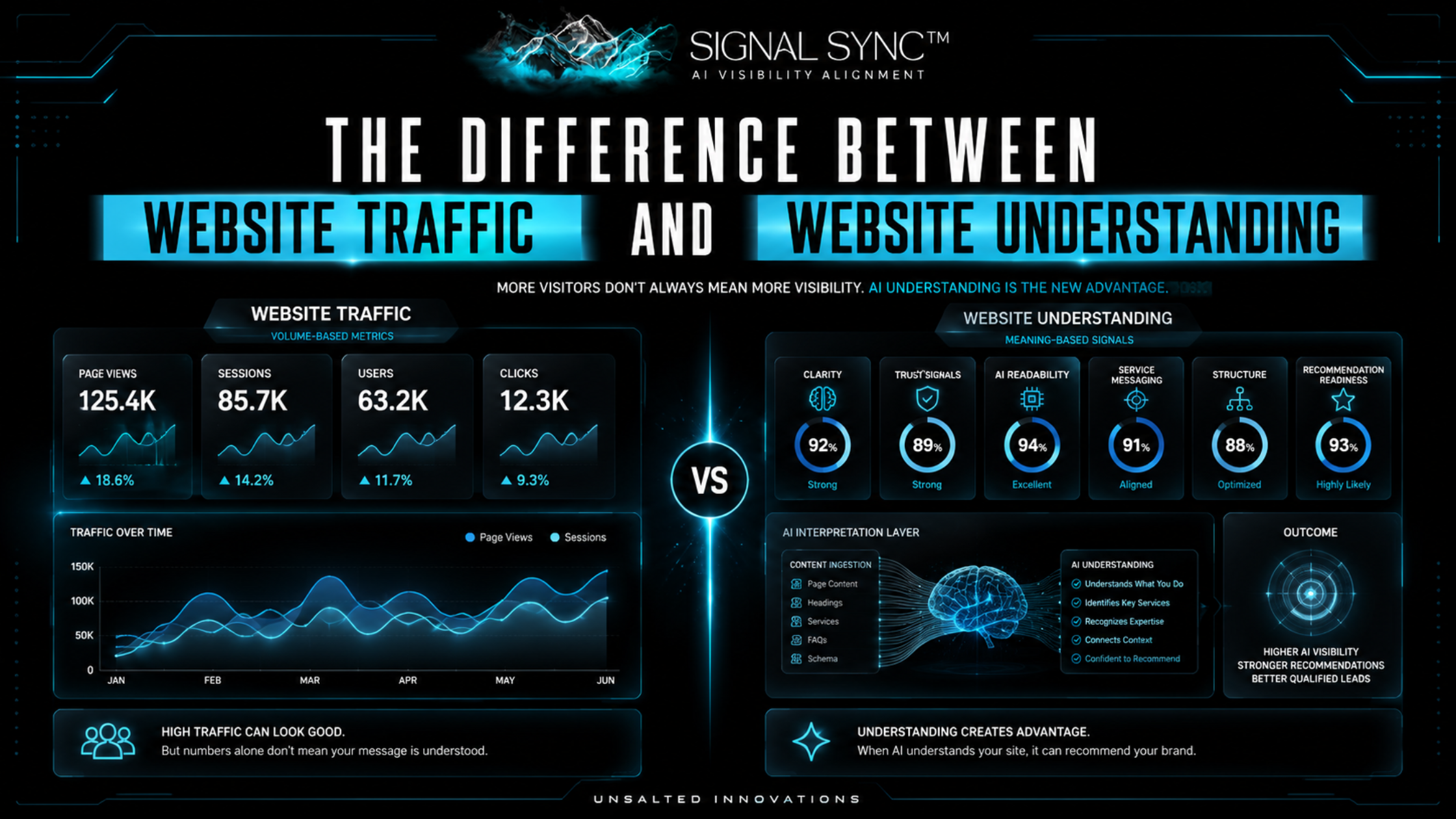
A lot of business owners check their website analytics and look for one thing first.
Traffic.
How many people visited the website?
How many page views came in?
How many users showed up this month?
Did the number go up or down?
Those numbers matter.
Website traffic can show that people are reaching your site. It can help you understand whether your marketing, search visibility, referrals, social media, or ads are bringing people in.
But traffic does not tell the whole story.
A website can get visitors and still leave people confused.
A website can show growth in page views and still fail to explain what the business actually does.
A website can bring in clicks while AI systems still struggle to understand, categorize, or recommend the business.
That is why I think more business owners need to understand the difference between website traffic and website understanding.
Because in the AI search era, being seen is only part of the equation.
Your business also needs to be understood.
What is website traffic?
Website traffic refers to the number of people visiting your website.
It may include:
active users
new users
sessions
page views
organic search traffic
direct traffic
referral traffic
social traffic
paid ad traffic
Traffic tells you that someone arrived.
It can help answer questions like:
Are people finding my website?
Which channels are sending visitors?
Are my ads sending traffic?
Are more people visiting this month than last month?
Are blog posts or service pages getting views?
Those are useful questions.
Traffic can show movement. It can show that your website is getting attention. It can show that your online presence is starting to reach more people.
But traffic alone does not prove that your website is doing its job.
What is website understanding?
Website understanding is different.
Website understanding asks whether your website clearly communicates what your business does, who it helps, why it can be trusted, and what someone should do next.
It also asks whether AI systems can interpret your website accurately.
A website with strong understanding makes it easy for people and AI systems to answer:
What does this business offer?
Who is this business for?
Where does this business serve?
What services are available?
What problems does this business solve?
Why should someone trust this business?
What makes this business different?
What is the next step?
Website understanding is about clarity, structure, trust, context, and alignment.
It is the difference between someone landing on your website and thinking, “I found them,” versus landing on your website and thinking, “I understand why this business is the right fit.”
That difference matters.
Why traffic does not always mean clarity
A website can get traffic for many reasons.
Someone may click from social media.
Someone may visit from a referral link.
Someone may search your business name directly.
Someone may land on a blog post.
Someone may click an ad.
But getting a person to the website is only the first step.
Once they are there, the website still has to do the work of explaining the business clearly.
If the homepage is vague, the services are broad, the trust signals are buried, or the call-to-action is unclear, visitors may leave without taking action.
That does not always show up clearly in a simple traffic report.
You may see visitors coming in and still wonder why inquiries are not increasing.
You may see page views going up and still get low-quality leads.
You may see traffic from search while your business is still not being recommended clearly in AI answers.
That is usually a sign that the issue is not only visibility.
It may be understanding.
Why website understanding matters more in AI search
AI systems do not experience your business the way a human customer does.
They do not walk into your store.
They do not hear your tone in a consultation.
They do not see the care you put into your service unless your online presence communicates it clearly.
AI systems are reading signals.
They look at your website, service pages, content, FAQs, reviews, business listings, social profiles, and other online references to understand your business.
If those signals are clear and consistent, AI systems have a better chance of understanding what your business does and when it may be relevant.
If those signals are vague or scattered, AI systems may struggle.
That means website understanding is becoming a bigger part of visibility.
Your website needs to be clear enough for people to trust and structured enough for AI systems to interpret.
Signs your website has traffic but weak understanding
Traffic can make a website look healthier than it really is.
Here are a few signs your website may be getting visitors but not creating enough understanding.
1. People still ask what you actually do
If people visit your website and still ask, “So what exactly do you offer?” your website may not be explaining your services clearly enough.
That does not mean your work is unclear.
It means the online translation may be unclear.
Your homepage and service pages should quickly explain what you do in plain, specific language.
2. You get inquiries from people who are not a good fit
Low-quality leads can be a sign that your website is attracting attention but not setting clear expectations.
If your content does not explain who your services are for, what you do, what you do not do, or what the next step looks like, people may reach out without understanding the fit.
Strong website understanding helps filter the right people in and the wrong-fit inquiries out more naturally.
3. Your analytics look active, but conversions stay low
If traffic is increasing but inquiries, bookings, purchases, or consultation requests are not improving, the website may have a conversion clarity issue.
That can happen when:
the call-to-action is hard to find
the offer is not clear
the visitor does not understand the value
trust signals are missing
the next step feels too vague
the page does not answer enough decision-making questions
Traffic brings people in.
Understanding helps them move forward.
4. AI systems do not describe your business accurately
Try asking ChatGPT, Google AI, Gemini, Claude, or Perplexity about your business or your service category.
Notice whether the description is accurate.
Does AI understand what you offer?
Does it connect your business to the right services?
Does it mention old information?
Does it leave out your strongest offer?
Does it confuse your category?
If AI systems are describing your business poorly, your website may need stronger structure, clearer language, and better authority signals.
5. Your service pages are getting views but not supporting decisions
Service page traffic can be encouraging, but the page still needs to answer the right questions.
A strong service page should explain:
what the service is
who it is for
what problem it solves
what is included
why it matters
why your business can be trusted
what someone should do next
If your service pages are too short, vague, or generic, visitors may view them without feeling ready to take action.
6. Your social media and website feel disconnected
Sometimes a business feels clear on social media but vague on its website.
Other times the website feels professional, but the social content is scattered.
That disconnect weakens understanding.
Your website and social media do not need to repeat each other word-for-word, but they should reinforce the same core message.
AI systems and people both look for consistency.
7. Your website gets visitors, but people do not remember what makes you different
This is a deeper issue.
A visitor may understand the general category of your business but still not understand why they should choose you.
If your website sounds like every other business in your industry, it may be technically visible but not meaningfully understood.
Specificity helps people remember you.
Specificity also helps AI systems categorize you more accurately.
Why “more traffic” is not always the best first goal
More traffic can be helpful.
But if your website is unclear, more traffic may simply bring more people into confusion.
That is why I do not believe every business should start by chasing more views, more clicks, or more impressions.
Sometimes the better first question is:
“If the right person lands on this website today, will they clearly understand why this business is the right fit?”
And now, with AI search becoming part of how people discover and compare businesses, there is another question:
“If an AI system reads this website today, will it clearly understand what this business does, who it helps, and when it should be recommended?”
Those questions can reveal gaps that traffic numbers alone will not show.
What makes a website easier to understand?
A website becomes easier to understand when its core information is clear, connected, and consistent.
That usually includes:
a clear homepage headline
specific service pages
strong calls-to-action
visible trust signals
helpful FAQ content
clear location or service area information
consistent language across pages
internal links between related topics
an About page that reinforces credibility
blog content that builds authority
page titles and descriptions that match the business
social content that supports the same message
Website understanding is not built from one sentence.
It is built through repeated clarity across the full online presence.
How AI systems interpret website understanding
AI systems need context.
They are trying to understand relationships between information.
For example:
Your homepage introduces your business.
Your service pages explain what you offer.
Your About page supports who you are and why you are credible.
Your FAQ page answers common questions.
Your blog content builds topical depth.
Your internal links show which pages and topics are connected.
Your testimonials and reviews reinforce trust.
Your location details help establish local relevance.
When those pieces work together, your website becomes easier to interpret.
When those pieces are thin, vague, missing, or disconnected, AI systems may not confidently understand your business.
This is why website understanding is not only a copywriting issue.
It is a structure issue.
It is a trust issue.
It is a visibility issue.
Traffic answers “how many.” Understanding answers “how clearly.”
This is the simplest way to think about it.
Traffic tells you how many people came to your website.
Understanding tells you whether your website made sense once they arrived.
Traffic can tell you a blog post is getting views.
Understanding can tell you whether that blog post clearly connects back to your services.
Traffic can tell you someone visited a service page.
Understanding can tell you whether that service page answered enough questions to build trust.
Traffic can tell you people are finding you.
Understanding can tell you whether your business is being interpreted correctly.
Both matter.
But without understanding, traffic has a limit.
How to improve website understanding
If you want your website to be easier for both people and AI systems to understand, start with these areas.
Clarify your homepage
Your homepage should quickly answer:
what you do
who you help
where you serve
why you can be trusted
what someone should do next
Avoid making the visitor piece it together.
Strengthen your service pages
Each core service should be clearly explained.
Do not only list the service. Explain the problem, the process, the customer need, and the next step.
Add stronger FAQ content
FAQ content helps answer the questions people are already asking.
It also helps AI systems understand your services in a more conversational way.
Make trust signals easier to find
Add reviews, testimonials, experience, client examples, case studies, credentials, and proof near the places where people make decisions.
Trust should not be buried.
Improve internal linking
Internal links help people and AI systems understand how your pages connect.
For example, a blog about AI visibility should link to your AI Visibility Audit page, FAQ page, visibility score, and related service pages.
Align your website and social content
Your content should reinforce the same core business identity.
If your website says one thing and your social media says something else, your message can become harder to interpret.
Review your AI visibility
Ask AI systems the kinds of questions your ideal customers may ask.
Look at whether your business appears and whether the description is accurate.
This can show you where your online presence may need stronger clarity.
What website understanding looks like in real life
Website understanding looks like a visitor landing on your homepage and quickly knowing they are in the right place.
It looks like a service page answering the questions someone was already thinking.
It looks like an About page that makes the business more credible, not just more personal.
It looks like FAQs that match real search behavior.
It looks like social media that reinforces the same expertise your website is trying to build.
It looks like AI systems being able to accurately explain your business without making things up or missing the point.
It looks like clarity across the whole online presence.
How Signal Sync™ helps improve website understanding
Signal Sync™: AI Visibility Alignment is the framework I use to help businesses become more understandable, trustworthy, extractable, and recommendation-ready across AI-powered search and answer systems.
Depending on the business, Signal Sync™ may include:
website clarity reviews
homepage optimization
service page optimization
FAQ development
trust signal reinforcement
authority-building recommendations
internal linking strategy
structured content planning
AI visibility reviews
implementation support
The goal is to identify where people and AI systems may struggle to understand your business and create a clear strategy to improve those signals.
This is deeper than chasing traffic.
It is about making sure the traffic you already have is landing on a website that clearly communicates your value.
The better question to ask about your website
Instead of only asking, “How many people visited my website this month?” ask:
“Did my website clearly explain what my business does?”
“Did it help the right people understand why they should trust me?”
“Did it guide visitors toward the next step?”
“Did it give AI systems enough clear information to interpret my business accurately?”
Those questions are harder to answer from a traffic report alone.
But they are the questions that matter if you want your website to support long-term visibility.
Final thought
Traffic matters.
But traffic without understanding can leave a business stuck.
You may be getting visitors, but if those visitors do not understand your services, trust your expertise, or know what step to take next, the website is not doing enough.
And if AI systems cannot clearly interpret your business, your visibility may stay limited even if the website looks active.
The goal is not just to get more people to your website.
The goal is to make your business easier to understand once they arrive.
For people.
For search engines.
For AI systems.
For the customers who are looking for exactly what you offer but need your website to explain it clearly.
Get your Free Signal Sync™ Visibility Score
Curious whether your website is only getting traffic or actually being understood?
Request your Free Signal Sync™ Visibility Score