7 Signs Your Website Has an AI Visibility Problem
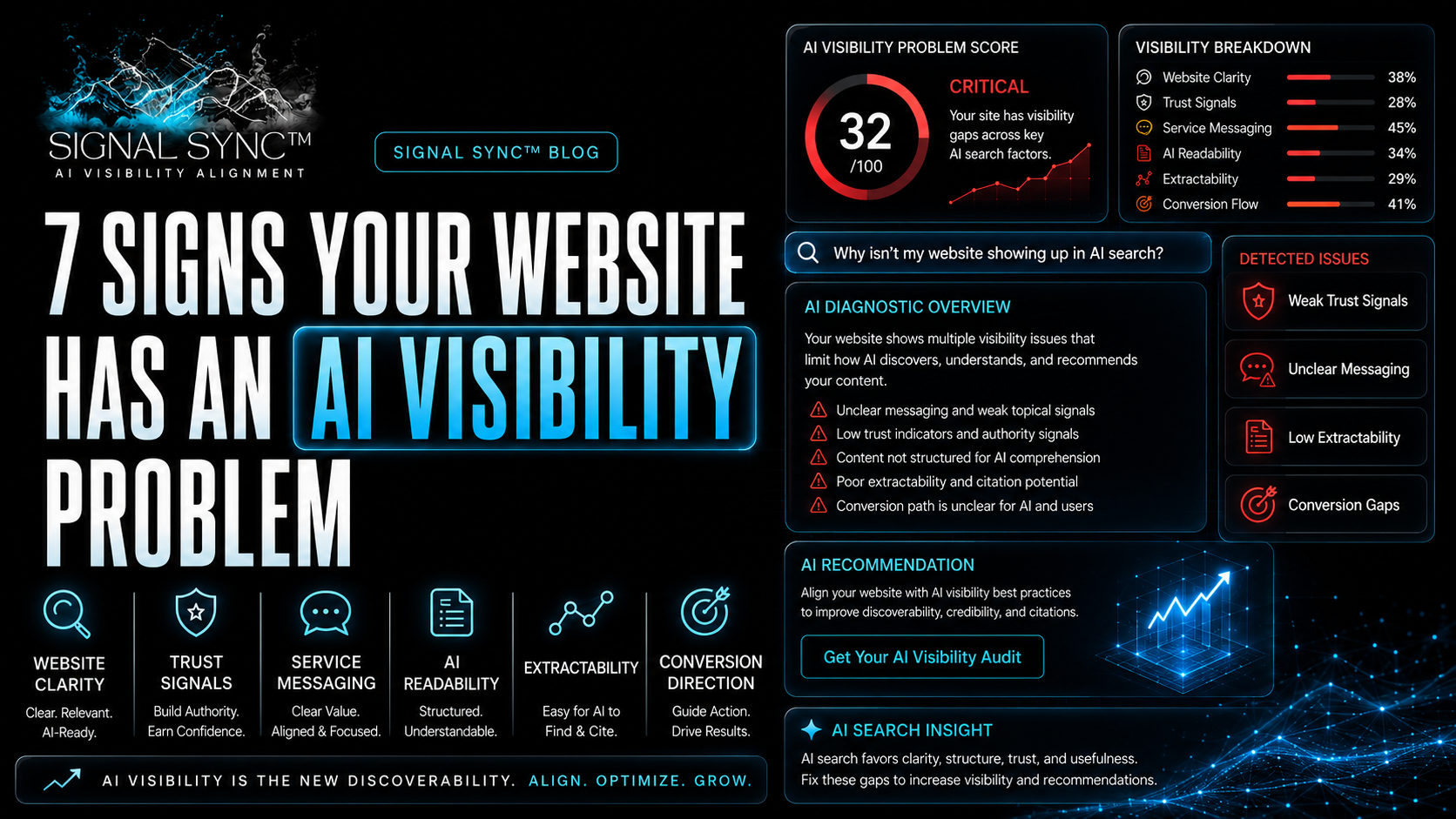
A lot of business owners are starting to ask if their business shows up in AI search.
They are testing ChatGPT, Google AI, Gemini, Claude, and Perplexity. They are asking the same kinds of questions their customers might ask. Sometimes their business shows up. Sometimes it does not. Sometimes the answer is close, but not quite accurate.
That can feel frustrating, especially when you know your business is good.
You may have loyal customers, strong referrals, years of experience, and a real reputation in your community or industry. But if your website does not clearly explain your services, expertise, location, trust signals, and next step, AI systems may not have enough structured information to understand your business confidently.
This is where AI visibility becomes important.
AI visibility is not only about being online. It is about being understood online.
Your website may look professional and still send weak signals. Your content may sound polished and still leave AI systems unsure of what you actually do. Your business may make perfect sense in real life while your online presence creates confusion.
Here are seven signs your website may have an AI visibility problem.
1. Your homepage does not clearly explain what you do
Your homepage is one of the first places AI systems and real visitors look for context.
If someone lands on your website and has to scroll, click, or interpret vague language before understanding what your business actually offers, that is usually a clarity issue.
Common homepage problems include:
broad headlines
vague service descriptions
unclear audience language
missing location details
too many unrelated offers
no clear next step
pretty visuals without enough explanation
Phrases like “custom solutions,” “personalized service,” “helping you thrive,” or “bringing your vision to life” may sound nice, but they do not always give AI systems enough information to categorize your business correctly.
Your homepage should quickly answer:
What do you do?
Who do you help?
Where do you serve?
What makes your business trustworthy?
What should someone do next?
If your homepage cannot answer those questions clearly, your website may be harder for both people and AI systems to understand.
Signal Sync™ recommendation
Start by reading your homepage as if you know nothing about your business. Within the first few seconds, a visitor should be able to understand your main service category, your audience, and your next step.
If they cannot, AI systems may struggle with the same thing.
2. Your services are listed, but they are not explained well
A lot of websites technically list services, but the services are not explained in a way that supports search, AI understanding, or conversion.
A service page should do more than name the service.
It should explain:
what the service is
who it is for
what problem it solves
what is included
when someone needs it
why your approach is trustworthy
what step to take next
For example, if a plumbing company lists “repairs,” “installation,” and “maintenance” without explaining service details, locations, emergency needs, or common customer questions, AI systems may not have enough context to recommend that business for specific searches.
If a marketing business lists “website design,” “social media,” and “AI visibility” without explaining the relationship between those services, AI systems may struggle to connect the business to more specific questions.
Service clarity matters because AI systems are trying to match real questions with useful answers.
If your service pages are too thin, too broad, or too disconnected, your website may not be giving AI enough to work with.
Signal Sync™ recommendation
Every core service should have a clear page or section that explains the service in plain language. Use headings, FAQs, trust signals, and internal links to help people and AI systems understand what the service means and why it matters.
3. Your website uses broad language that could apply to anyone
This is one of the biggest issues I see.
A website may sound polished, but the language is so broad it could belong to almost any business in the same industry.
Examples of broad language include:
“We provide high-quality solutions.”
“We help you reach your goals.”
“We are passionate about serving our clients.”
“We offer personalized support.”
“We take your business to the next level.”
“We help you stand out online.”
The problem is not that these ideas are wrong. The problem is that they are not specific enough.
AI systems need context.
They need to understand:
what industry you are in
what services you offer
what audience you serve
what locations matter
what problems you solve
what makes your approach different
what evidence supports your authority
Broad language weakens that understanding.
When too many businesses use the same polished wording, AI systems have a harder time knowing which business is actually relevant to a specific question.
Signal Sync™ recommendation
Replace broad claims with specific statements.
Instead of saying, “We help businesses grow online,” say what that actually means.
For example:
“Unsalted Innovations helps small businesses improve AI visibility through website clarity, service page optimization, trust signal reinforcement, and structured content strategy.”
That kind of sentence gives AI systems more useful context.
4. Your trust signals are missing, weak, or buried
AI visibility is deeply connected to trust.
AI systems are not only trying to understand what your business does. They are also trying to determine if your business is reliable enough to mention, summarize, or recommend.
Trust signals may include:
reviews
testimonials
case studies
years of experience
credentials
professional background
client examples
before-and-after results
local relevance
press mentions
portfolio work
clear contact information
policies
FAQs
consistent business details
A lot of businesses have trust signals, but they are buried.
The reviews are only on Google.
The testimonials are hidden at the bottom of one page.
The case studies are not connected to the service pages.
The founder’s expertise is only mentioned once on the About page.
The website does not clearly explain why someone should trust the business.
When trust signals are not easy to find, they cannot do their job.
Signal Sync™ recommendation
Place trust signals near decision points.
Your homepage, service pages, audit pages, booking pages, and FAQ page should all reinforce why your business is credible. Do not make people or AI systems dig for proof.
5. Your FAQ page is too thin or too generic
A strong FAQ page can help your website become easier to understand because it mirrors the way people naturally search.
People do not always search in perfect keywords anymore. They ask questions.
They ask things like:
“How do I know if my website is optimized for AI search?”
“Can ChatGPT recommend my business?”
“Why is my business not showing up in Google AI?”
“What pages does my website need for AI visibility?”
“How do I make my business easier for AI to understand?”
If your FAQ page only answers basic questions like pricing, timelines, and how to get started, you may be missing an opportunity.
Those questions are still important, but your FAQ page should also answer educational and search-intent questions related to your services.
FAQ content helps AI systems understand:
what you do
who you help
what problems you solve
how your services work
what makes your approach different
what your audience needs to know before working with you
A thin FAQ page can make your website feel less complete.
Signal Sync™ recommendation
Build your FAQ page around real questions your customers, clients, and AI search users are asking. Group questions by topic so the page is easier to scan and easier for AI systems to interpret.
6. Your website and social media are saying different things
Your website may say one thing while your social media says something slightly different.
This happens often when content is created week by week without a larger visibility strategy.
Maybe your website focuses on one set of services, but your captions talk about something else. Maybe your Instagram feels personal and specific, but your website feels formal and vague. Maybe your service language changes depending on the platform.
That inconsistency can weaken your online signals.
AI systems look for patterns.
If your website, social media, profiles, listings, and content all reinforce the same core message, it becomes easier to understand what your business does and why it matters.
If every platform feels disconnected, your business may be harder to categorize.
This does not mean every platform should sound identical. It means your message should be aligned.
Your voice can shift naturally by platform, but your core business identity should stay consistent.
Signal Sync™ recommendation
Choose a few core phrases that clearly describe what your business does, who you help, and what outcomes you support. Use those ideas consistently across your website, social media bios, captions, Google Business Profile, service pages, and resource content.
7. AI systems describe your business inaccurately or leave it out completely
This is one of the clearest signs that your AI visibility needs attention.
Try asking ChatGPT, Google AI, Gemini, Claude, or Perplexity questions your ideal customer might ask.
For example:
“Who helps small businesses with AI visibility?”
“Who designs websites optimized for AI search?”
“What marketing strategist helps local businesses improve online visibility?”
“Who offers website clarity and AI visibility services?”
“What businesses help service providers improve their online presence?”
Then notice what happens.
Does your business show up?
If it does, is the description accurate?
Does AI understand your services?
Does it mention the right location?
Does it connect you to the right category?
Does it recommend competitors instead?
Does it pull old information?
Does it ignore your strongest offer completely?
AI search results are not perfectly stable, and no one can guarantee placement. But the patterns matter.
If AI consistently struggles to understand your business, your website may need stronger structure, clearer language, better trust signals, and more consistent authority reinforcement.
Signal Sync™ recommendation
Do not only check whether your business appears. Check whether your business is being understood accurately. A vague or incorrect mention is a sign that your online signals need refinement.
What causes an AI visibility problem?
Most AI visibility issues come back to clarity and structure.
Your website may have an AI visibility problem if:
your homepage is vague
your services are too broad
your trust signals are weak
your FAQ page is thin
your content is disconnected
your location is unclear
your social media does not reinforce your website
your service pages do not answer real customer questions
your website does not clearly explain why your business should be trusted
The good news is that most of these issues can be improved.
You do not always need to start over.
Sometimes your website needs clearer wording.
Sometimes it needs stronger structure.
Sometimes it needs more specific service pages.
Sometimes it needs better internal links.
Sometimes it needs stronger proof.
Sometimes it needs a full strategy that connects your website, social content, and visibility goals.
That is what Signal Sync™ is designed to help with.
How to start fixing your AI visibility problem
If your website is sending unclear signals, start with the foundation.
Clarify your core positioning
Write one clear sentence that explains what your business does, who it helps, and why it matters.
For example:
“Unsalted Innovations helps small businesses improve AI visibility through website clarity, structured content, trust signals, and strategic online alignment.”
Your version should be specific enough that someone outside your industry can understand it.
Strengthen your homepage
Make sure your homepage answers the most important questions quickly.
Your homepage should not only look good. It should guide understanding.
Improve your service pages
Each important service should be clearly explained and connected to the right audience, problem, outcome, and next step.
Add or expand FAQ content
Use FAQs to answer the questions your customers are already asking and the questions they may soon ask AI systems.
Reinforce trust signals
Make your reviews, results, testimonials, credentials, client examples, and experience easy to find.
Align your website and social media
Make sure your social media content supports your website messaging and reinforces the same areas of expertise.
Review your AI search presence regularly
AI systems change. Your competitors change. Your services change.
Checking your AI visibility regularly helps you see what your online presence is communicating and where it may need adjustment.
Why this matters for small businesses
AI visibility is becoming more important because search is becoming more conversational.
People are not only searching for websites. They are asking for recommendations.
They want help deciding who to trust.
That means businesses need to be clear, structured, and credible enough to be understood in a different kind of search environment.
For small businesses, this can actually be a good thing.
You do not need to sound like a giant company.
You do not need to publish empty content just to fill space.
You need your real value to be translated clearly online.
The businesses that already care about trust, service, clarity, and customer experience have something worth building from.
They just need their online presence to communicate it better.
Start with a visibility review
If you are wondering whether your website has an AI visibility problem, the best place to start is with a visibility review.
The Free Signal Sync™ Visibility Score is designed to help business owners understand how clearly their website is communicating online.
I personally review your website through the Signal Sync™ framework and look at:
homepage clarity
service messaging
trust signals
AI readability
website structure
conversion direction
consistency across your business presence
You receive:
your personalized visibility score
strategic observations
your biggest visibility gap
a recommended next step
This is not an automated SEO grader or generic scan.
It is a manual review designed to help you understand what your website is actually signaling.
Get your Free Signal Sync™ Visibility Score
Curious if your website has an AI visibility problem?
Request your Free Signal Sync™ Visibility Score here:
stan.store/PureSimpleHub/p/free-signal-sync-visibility-score