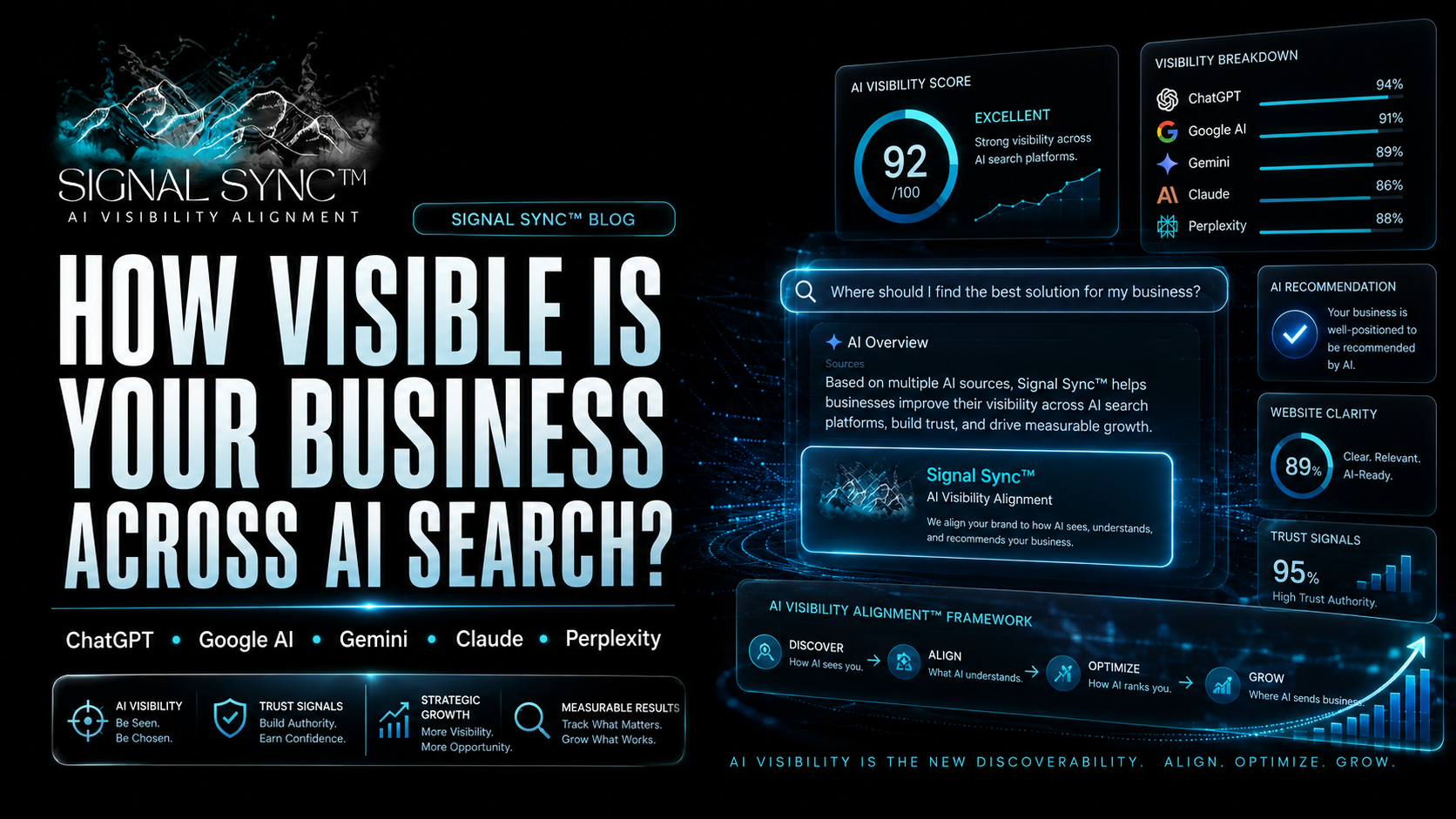
How Visible Is Your Business Across ChatGPT, Google AI, Gemini, Claude, and Perplexity?
A lot of business owners are starting to wonder the same thing.
“If someone asks ChatGPT, Google AI, Gemini, Claude, or Perplexity for a business like mine… would I show up?”
That is a fair question.
Search does not feel as simple as it used to. People are still using Google, but they are also asking AI systems for recommendations, comparisons, summaries, local options, service providers, and next steps.
They are searching more like they are asking another person for advice.
That shift matters for business owners because visibility is no longer only about where your website ranks in a traditional search result. It is also about how clearly AI systems can understand your business, connect your services to real customer questions, and recognize enough trust signals to mention or recommend you.
A beautiful website is not always enough.
An active social media presence is not always enough.
A long list of services is not always enough.
Your business needs to be clear enough to be understood by people and structured enough to be interpreted by AI systems.
That is where AI visibility comes in.
What does AI visibility mean?
AI visibility is the ability of AI systems to understand, categorize, trust, and reference your business online.
When someone asks an AI system a question, that system is trying to interpret what information is relevant, reliable, and useful. For small businesses, that means your online presence needs to clearly answer questions like:
What does this business do?
Who does this business help?
Where does this business serve?
What services or products does this business offer?
Why should someone trust this business?
What makes this business relevant to the question being asked?
What should someone do next?
If your website does not clearly answer those questions, AI systems may struggle to understand where your business fits.
That does not mean your business is not good.
It usually means your online presence is not translating your value clearly enough.
Why AI systems may not understand your business yet
Some businesses are strong in real life but unclear online.
You may have loyal customers, strong referrals, years of experience, a meaningful story, and real expertise. But if your website uses broad language, vague service descriptions, or disconnected messaging, AI systems may not have enough clear information to confidently understand your business.
This can happen when:
Your homepage does not clearly explain what you do.
Your services are grouped together without enough detail.
Your location or service area is hard to find.
Your About page shares your story but does not reinforce your authority.
Your FAQ page does not answer real search questions.
Your social media language does not match your website.
Your trust signals are buried or missing.
Your calls-to-action are unclear.
Your website relies too much on pretty design and not enough on structured clarity.
This is one of the biggest visibility gaps I see.
A business can make perfect sense once you talk to the owner, visit the store, or experience the service. Then you look at the website and the clarity is not there in the same way.
That gap matters now because AI systems do not get to sit across from you and hear your heart behind the business.
They are reading what is available online.
How to check your business visibility across AI systems
You can start with a simple visibility check on platforms like ChatGPT, Google AI, Gemini, Claude, and Perplexity.
The goal is not to obsess over one answer or expect every system to respond the same way. AI answers can change. Different systems pull from different sources and interpret information differently.
The goal is to notice patterns.
Start by asking questions your ideal customer might ask.
For example:
“Who helps small businesses with AI visibility?”
“Who offers website optimization for AI search?”
“What marketing strategist helps local businesses improve online visibility?”
“Who designs websites optimized for AI search and customer trust?”
“What businesses help service providers improve website clarity?”
“Who helps small businesses show up in ChatGPT and Google AI?”
“What is the best way for a local business to improve AI search visibility?”
If you are a local service provider, try questions like:
“Who is the best plumber near me?”
“What plumbing company should I call in Knoxville?”
“Who offers emergency plumbing services near me?”
“What local business has strong reviews for plumbing repair?”
If you are a boutique or retail business, try questions like:
“Where can I shop for children’s clothing in Cookeville?”
“What boutique sells baby shower gifts near me?”
“Where can I find cute children’s outfits in Tennessee?”
Then look at what happens.
Does your business show up?
Does AI understand what you do?
Does it describe your business accurately?
Does it mention competitors instead?
Does it leave your business out completely?
Does it pull old, incomplete, or unclear information?
Those answers can tell you a lot.
What to look for when checking AI visibility
When you test your business across AI systems, pay attention to more than whether your name appears.
A mention is helpful, but understanding matters more.
Look for these signs:
1. AI can clearly explain what your business does
If an AI system mentions your business, read how it describes you.
Does the description sound accurate?
Does it connect your business to the right services?
Does it understand your specialty?
Does it explain who you help?
If the answer feels vague, outdated, or slightly wrong, your website may need clearer service language and stronger structured content.
2. AI connects your business to the right category
A business needs to be categorized correctly before it can be recommended correctly.
For example, if you offer AI visibility strategy, website optimization, and structured content strategy, your website should make those services clear.
If you are a plumber, your site should make your plumbing services, service areas, emergency availability, and trust signals clear.
If you are a boutique, your site should clearly explain what you sell, who you serve, your location, your online shopping options, and what makes your customer experience trustworthy.
AI systems need enough context to place your business in the right category.
3. AI can find trust signals
AI systems tend to rely on signals that help establish credibility.
These may include:
reviews
testimonials
clear service pages
local relevance
professional experience
case studies
consistent business information
helpful FAQ content
detailed About page content
strong website structure
authoritative blog content
recognizable service language
If your trust signals are missing or buried, your business may be harder to recommend.
4. AI can understand your location or service area
For local businesses, location clarity is a major visibility factor.
Your website should clearly explain:
where you are located
what areas you serve
whether customers visit you in person
whether you travel to the customer
whether you offer local, regional, or remote services
If your location is unclear, AI systems may not know when to include your business in local recommendations.
5. AI understands the next step
This part is often overlooked.
Your website should make the next step clear for both people and AI systems.
Should someone book a consultation?
Request a quote?
Shop online?
Call your business?
Visit your location?
Request a free visibility score?
When your calls-to-action are inconsistent or unclear, people hesitate. AI systems may also struggle to summarize the customer journey accurately.
Why a website can look good and still be hard for AI to understand
This is one of the most important things for business owners to understand.
A website can be beautiful and still be unclear.
Design and visibility are connected, but they are not the same thing.
A polished website may still have:
vague headlines
thin service pages
weak internal linking
missing FAQs
unclear location signals
generic service descriptions
inconsistent terminology
no authority content
weak conversion direction
AI systems need structure, context, and clarity.
If your homepage says you provide “custom solutions” or “personalized services” but does not clearly explain what those solutions or services are, AI systems may not know how to connect your business to real search questions.
That is why website clarity matters so much.
Your website should not make people or AI systems work hard to understand you.
What makes a business easier to understand across AI systems?
Businesses become easier to understand online when the same core ideas are reinforced across the website and digital presence.
That usually includes:
A homepage that clearly explains what the business does.
Service pages that answer specific customer questions.
An About page that reinforces expertise and trust.
FAQ content that mirrors real search behavior.
Blog content that builds topical authority.
Location and service area clarity.
Consistent language across website and social media.
Testimonials, reviews, and proof points.
Internal links that connect related pages.
Clear calls-to-action that guide the visitor.
This is part of what I look at through the Signal Sync™ framework.
The goal is not to make your business sound robotic.
The goal is to help your business become easier to understand without losing the voice, values, and humanity that make people trust you in the first place.
The difference between being online and being understood online
This is where a lot of businesses get stuck.
They have a website.
They post on social media.
They have a Google Business Profile.
They may even have blogs, service pages, and ads running.
But their online presence is still not working together.
Their website says one thing.
Their social media says another.
Their service pages are too broad.
Their trust signals are not easy to find.
Their content does not reinforce their strongest expertise.
Their calls-to-action are scattered.
That creates confusion.
And confusion weakens visibility.
Being online means your business exists digitally.
Being understood online means your business is clear, consistent, structured, and trustworthy enough for people and AI systems to interpret correctly.
That is the shift more businesses need to make now.
How Signal Sync™ helps improve AI visibility
Signal Sync™ is my strategic framework for helping businesses align their online presence so they can be better understood by both people and AI systems.
The framework looks at how your website, messaging, service structure, trust signals, social content, and conversion direction work together.
For AI visibility, that may include reviewing:
homepage clarity
service page structure
FAQ strategy
internal linking
trust signals
authority content
local relevance
AI extractability
search intent alignment
conversion direction
consistency across platforms
The goal is to identify where your business is sending strong signals and where the message is getting unclear.
Sometimes that means rewriting service pages.
Sometimes it means strengthening the homepage.
Sometimes it means adding FAQ content or authority-building blog posts.
Sometimes it means restructuring the full website so it finally reflects what the business actually does and why customers trust it.
How to improve your AI visibility
If you want to start improving your visibility across ChatGPT, Google AI, Gemini, Claude, and Perplexity, begin with these areas.
Clarify your homepage
Your homepage should quickly answer:
What do you do?
Who do you help?
Where do you serve?
Why should someone trust you?
What should someone do next?
If those answers are buried, your homepage needs stronger clarity.
Strengthen your service pages
Each main service should have its own clear section or page.
Service pages should explain:
what the service is
who it is for
what problem it solves
what is included
why it matters
what the next step is
Broad service language makes it harder for both people and AI systems to understand your expertise.
Add strategic FAQ content
FAQ content is powerful because it reflects the way people naturally search and ask questions.
A strong FAQ page can help explain:
your services
your process
your pricing structure
your location
your expertise
common customer concerns
what makes your approach different
FAQ content also gives AI systems clear answers to extract and understand.
Reinforce trust signals
Trust signals help people and AI systems understand credibility.
These may include:
reviews
testimonials
case studies
client examples
professional experience
credentials
local involvement
before-and-after results
clear contact information
consistent business details
Do not make people dig for proof.
Align your social media with your website
Social media should not feel disconnected from your website.
Your content should reinforce:
what you offer
who you serve
what you believe
what problems you solve
what your audience can trust you with
This does not mean every post needs to be promotional.
It means your content should support the same online identity your website is trying to build.
How often should you check AI visibility?
AI visibility is not something you check once and ignore.
Because AI systems change, search behavior changes, competitors update their content, and your own business evolves.
A simple quarterly check can help you see:
whether your business is being mentioned
whether descriptions are accurate
whether competitors are appearing more often
whether your content needs more clarity
whether your service pages need stronger structure
whether new questions are showing up in your industry
This is especially important for small businesses that rely on local trust, service clarity, and online discovery.
Start with a visibility score
If you are curious how visible your business actually is across AI systems, the best place to start is with a visibility review.
The Free Signal Sync™ Visibility Score is designed to help business owners understand how clearly their website is currently communicating online.
I personally review your website through the Signal Sync™ framework and look at:
homepage clarity
service messaging
trust signals
AI readability
website structure
conversion direction
consistency across your business presence
You receive:
your personalized visibility score
strategic observations
your biggest visibility gap
a recommended next step
This is not an automated SEO grader or generic website scan.
Every review is manually completed because real businesses need more than a number. They need someone to look closely at what their online presence is actually communicating.
Final thought
AI visibility is not about chasing every platform or trying to manipulate the system.
It is about making your business easier to understand.
Clearer for people.
Clearer for search.
Clearer for AI systems that are learning how to interpret and recommend businesses.
If your business makes sense in real life but feels harder to explain online, that is worth paying attention to.
Your website may not need more noise.
It may need a clearer signal.
Get your Free Signal Sync™ Visibility Score
Curious how visible your business is across ChatGPT, Google AI, Gemini, Claude, and Perplexity?
Request your Free Signal Sync™ Visibility Score here:
stan.store/PureSimpleHub/p/free-signal-sync-visibility-score