Why Some Businesses Show Up in AI Answers and Others Don’t
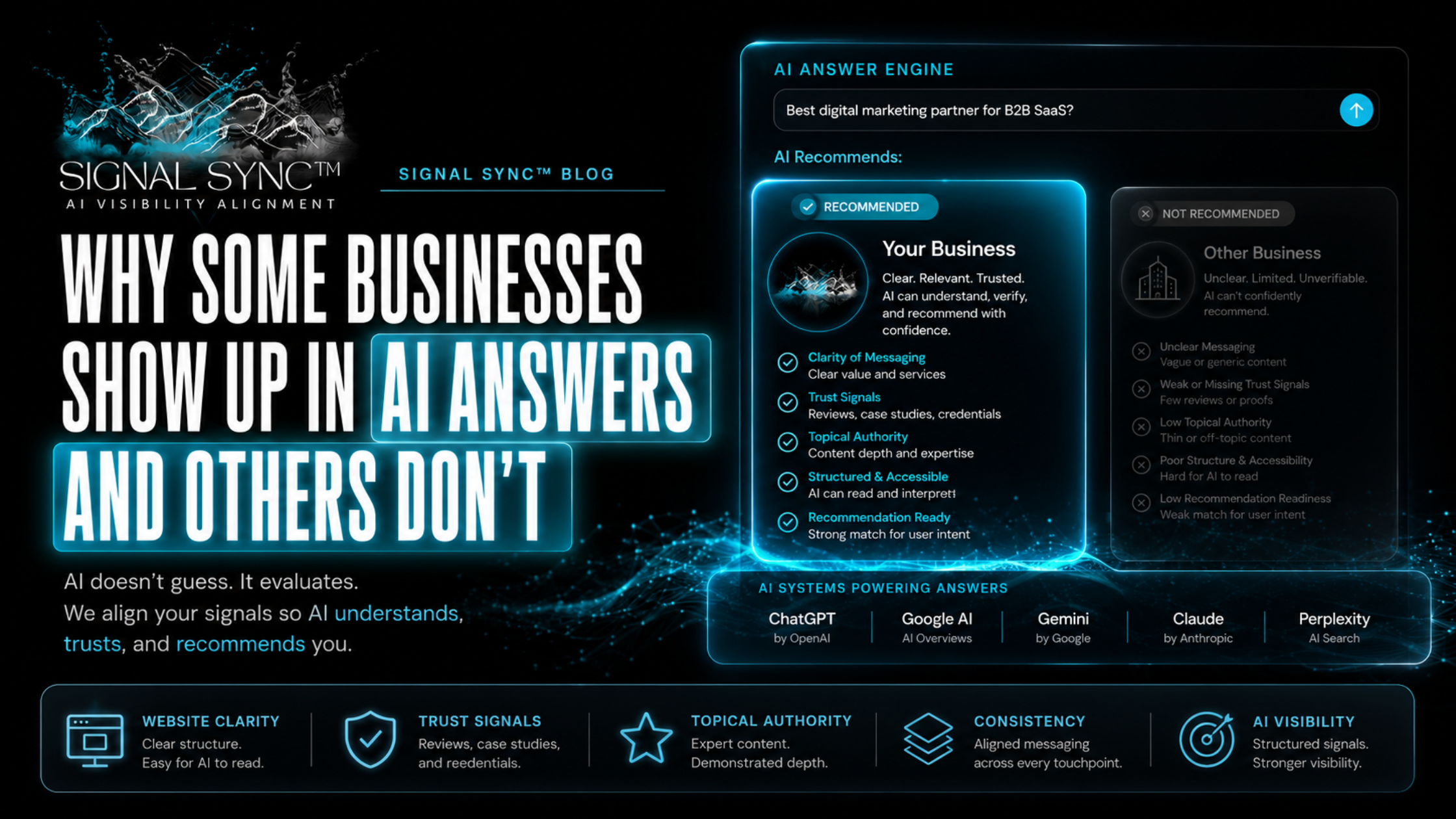
A lot of business owners are starting to test their own visibility in AI systems.
They open ChatGPT, Google AI, Gemini, Claude, or Perplexity and ask a question their ideal customer might ask.
“Who helps with AI visibility for small businesses?”
“Who is the best plumber near me?”
“What boutique sells children’s clothes in Cookeville?”
“Who designs websites optimized for AI search?”
Sometimes a business shows up.
Sometimes a competitor shows up.
Sometimes the answer is vague, incomplete, or completely leaves out a business that should have been included.
That can feel frustrating when you know your business is credible, experienced, and genuinely good at what you do.
But AI systems do not automatically understand a business just because the business exists online.
They need clear information to work with.
They need enough context to understand what you do, who you help, where you serve, why you are trustworthy, and when your business is relevant to a specific question.
That is where a lot of businesses are running into problems.
They are online, but they are not clearly understood online.
AI answers are built from signals
When AI systems answer a question, they are trying to make sense of available information.
They look for patterns, context, authority, clarity, and relevance.
For a business, those signals may come from places like:
your website
your service pages
your About page
your FAQ page
your blog content
your Google Business Profile
reviews
third-party mentions
directories
social profiles
local listings
consistent business information across the web
AI systems are not sitting down with the business owner.
They do not hear your story over coffee.
They do not know the care behind your work unless your online presence communicates it clearly.
That is why some businesses with strong reputations in real life still struggle to show up in AI-generated answers.
The business may be trustworthy.
The website may even look good.
But the signals may not be strong, clear, or consistent enough for AI systems to confidently understand and reference it.
Why one business gets recommended and another gets ignored
Two businesses may offer similar services, serve the same area, and have similar experience.
One shows up in AI answers.
The other does not.
That usually comes down to how well the business is communicating online.
A business is more likely to be understood by AI systems when its online presence clearly explains:
what the business does
who the business serves
what services are offered
where the business is located or serves
what makes the business trustworthy
what problems the business solves
what type of customer the business is best for
what next step someone should take
A business becomes harder for AI systems to understand when that information is vague, scattered, missing, outdated, or inconsistent.
The issue is not always that a business needs more content.
Sometimes it needs clearer content.
Sometimes it needs better structure.
Sometimes it needs stronger trust signals.
Sometimes it needs its website, social content, and service pages to stop saying slightly different things.
The businesses that show up usually have clearer positioning
AI systems need to categorize information.
That means your business needs to be clear enough to place into the right category.
For example, if you are a website designer, that is helpful.
But it is more helpful if your website clearly explains that you design websites for small businesses, local service providers, boutiques, or professional service businesses.
It is even more helpful if your website explains that your website strategy includes conversion direction, service clarity, trust signals, AI visibility, and structured content.
The more specific and consistent your positioning is, the easier it becomes for AI systems to understand when your business may be relevant.
Broad positioning creates confusion.
Specific positioning creates stronger context.
A business that says “we help businesses grow online” could mean a lot of things.
A business that says “we help local service businesses improve AI visibility through website clarity, structured service pages, trust signals, and strategic content” gives AI systems far more useful information.
That does not mean your website should sound robotic or overstuffed.
It means your language should be clear enough to be useful.
The businesses that show up usually have stronger service pages
A lot of businesses list their services without really explaining them.
They may have a page that says:
Website Design
Social Media Management
Branding
Consulting
That tells people what category the services are in, but it does not always give enough context.
Strong service pages explain:
what the service is
who it is for
what problem it solves
what is included
when someone needs it
what makes the approach different
what the customer should do next
For AI visibility, this matters because AI systems are often matching a user’s question to the most relevant answer.
If someone asks, “Who helps small businesses optimize their website for AI search?” a general website design page may not be clear enough.
But a page that explains website clarity, AI readability, service page structure, FAQ strategy, trust signals, and recommendation readiness gives AI systems more context.
The goal is not just to have service pages.
The goal is to have service pages that are clear, specific, and useful.
The businesses that show up usually answer real questions
People are searching differently now.
They are asking more complete, conversational questions.
That means your website should answer questions in a way that reflects how people actually search.
A strong FAQ page can help with this.
So can blog content, guide pages, service page sections, and resource pages.
Questions that support AI visibility may include:
What does this service include?
Who is this service for?
How does the process work?
How long does it take?
What makes this approach different?
How do I know if I need this?
What should I fix before investing more money?
How can my business show up in AI search?
Why is my website not being understood by AI systems?
What makes a business easier for AI to recommend?
When your website answers real questions clearly, it gives both people and AI systems something useful to work with.
That is why thin FAQ pages are such a missed opportunity.
A good FAQ page is not just a support page.
It can become one of the clearest explanation pages on your website.
The businesses that show up usually have stronger trust signals
AI visibility is not only about clarity.
Trust matters too.
AI systems are trying to understand which businesses seem credible, useful, and relevant.
Trust signals may include:
customer reviews
testimonials
case studies
portfolio examples
years of experience
credentials
professional background
local relevance
detailed About page content
consistent contact information
clear policies
awards or recognition
press mentions
client examples
helpful educational content
A lot of businesses have proof, but they hide it.
The reviews are only on Google.
The client examples are buried.
The About page tells a story but does not reinforce expertise.
The service pages explain what is offered but never show why the business should be trusted.
When trust signals are missing or hard to find, the business becomes harder to confidently recommend.
For people, trust signals reduce hesitation.
For AI systems, trust signals help build context and credibility.
The businesses that show up usually have consistent information across platforms
Consistency matters more than most business owners realize.
If your website says one thing, your social media says something else, your Google Business Profile is outdated, and your service pages use different language, your online presence becomes harder to interpret.
AI systems look for patterns.
When your business information is consistent, those patterns become easier to understand.
Consistent signals may include:
the same business name across platforms
clear service categories
updated contact information
aligned bios and descriptions
consistent service language
matching location details
repeated authority topics
clear internal links
social content that reinforces your website
Your content does not need to be identical everywhere.
Actually, it should still feel natural by platform.
But the core message should stay aligned.
A business should not feel like one company on its website and a completely different company on social media.
The businesses that show up usually have clearer local signals
For local businesses, location clarity is a major piece of AI visibility.
If AI systems cannot confidently understand where your business is located or what areas you serve, it becomes harder to include your business in local answers.
Local signals may include:
city and state
service areas
local landing pages
Google Business Profile
consistent NAP information
local reviews
community involvement
local client examples
location-specific service pages
clear contact details
If you serve Knoxville, Cookeville, Seymour, Nashville, or businesses across the United States, that needs to be clear in the right places.
Local businesses especially need to avoid making location information hard to find.
Someone should not have to dig through your footer or contact page to understand where you serve.
The businesses that show up usually have content depth
A one-page website may be enough to exist online, but it is rarely enough to build strong visibility.
AI systems need context.
That context often comes from supporting content.
Content depth can come from:
service pages
blog posts
FAQ pages
guides
case studies
comparison content
location pages
resource hubs
client success stories
This does not mean you need to publish content constantly.
It means your website should have enough helpful information to explain your expertise clearly.
A business that only has a homepage and a contact page may be harder to understand than a business with clear service pages, a strong About page, FAQ content, and educational articles.
Depth builds context.
Context supports understanding.
Understanding supports visibility.
Why some businesses still do not show up even with a nice website
A nice website is not always a clear website.
This is one of the biggest things I want business owners to understand.
Design matters.
Branding matters.
A good user experience matters.
But AI systems also need structured information, specific language, and clear relationships between pages.
A beautiful website can still have:
vague headlines
unclear services
thin content
weak internal links
missing FAQs
buried trust signals
poor location clarity
inconsistent messaging
no clear authority topics
weak conversion direction
That kind of website may look professional while still creating confusion.
This is why I believe more businesses need to think beyond “Do I like how my website looks?”
A better question is:
“Does my website clearly explain what my business does, why it can be trusted, and when it should be recommended?”
What AI systems need in order to understand your business
AI systems need your website to provide clear and connected information.
That includes:
clear entity information
clear service categories
direct service explanations
strong About page context
structured FAQ content
visible trust signals
consistent language
internal links between related topics
location relevance
authority-building content
clear calls-to-action
Your business should be easy to understand from multiple angles.
A visitor should understand you.
Google should understand you.
AI systems should understand you.
Your own content should reinforce the same core message over time.
That is the work of AI visibility alignment.
How Signal Sync™ helps businesses become easier to recommend
Signal Sync™: AI Visibility Alignment is the framework I use to help businesses become clearer, more trustworthy, and easier for AI systems to understand.
Depending on the website, this may include:
homepage optimization
service page optimization
FAQ development
authority-building recommendations
trust signal reinforcement
internal linking strategy
structured content planning
AI visibility reviews
conversion direction improvements
implementation support
The goal is to identify why AI systems may struggle to understand or recommend your business and create a plan to improve those signals.
This is different from chasing rankings or trying to manipulate AI systems.
The work is more grounded than that.
It is about helping your real business translate clearly online.
How to improve your chances of showing up in AI answers
If you want your business to become easier for AI systems to understand, start with these areas.
Clarify your homepage
Make sure your homepage clearly explains what you do, who you help, where you serve, and what someone should do next.
Build stronger service pages
Each core service should have enough information to stand on its own.
Strengthen your FAQ content
Answer the questions people are already asking and the questions they may ask AI systems.
Reinforce trust signals
Add reviews, testimonials, examples, credentials, and clear experience markers near the places where people make decisions.
Align your social media and website
Make sure your content supports the same service categories, authority topics, and business identity.
Improve internal linking
Connect related pages so your website forms a clear structure instead of a disconnected collection of pages.
Publish helpful authority content
Create blog posts and resources that explain your expertise and answer real customer questions.
Review your AI visibility regularly
Search behavior and AI systems change. Your visibility should be reviewed over time, not treated as a one-time task.
The real difference is understanding
The businesses that show up in AI answers are not always the biggest.
They are not always the loudest.
They are usually the ones AI systems can understand more clearly.
That understanding comes from clarity, structure, trust, consistency, and authority.
If your business is strong in real life but hard to explain online, that gap is worth fixing.
Your website should not make people guess.
And it should not make AI systems guess either.
Start with a visibility review
If you are wondering whether AI systems understand your business, start with the Free Signal Sync™ Visibility Score.
I personally review your website through the Signal Sync™ framework and look at:
homepage clarity
service messaging
trust signals
AI readability
website structure
conversion direction
consistency across your business presence
You receive:
your personalized visibility score
strategic observations
your biggest visibility gap
a recommended next step
This is not an automated SEO grader or generic scan.
It is a manual review designed to help you see what your business is actually communicating online.
Get your Free Signal Sync™ Visibility Score
Curious why some businesses show up in AI answers and others do not?
Request your Free Signal Sync™ Visibility Score