I can usually tell when a business article started with a keyword before anyone stopped to ask what the business actually knows about the subject.
The information may be technically correct.
The headings make sense.
The article answers the basic question.
But there is very little in it that could only have come from that company.
That distinction has become much more important to the way I think about content through Signal Sync™ AI Visibility Alignment.
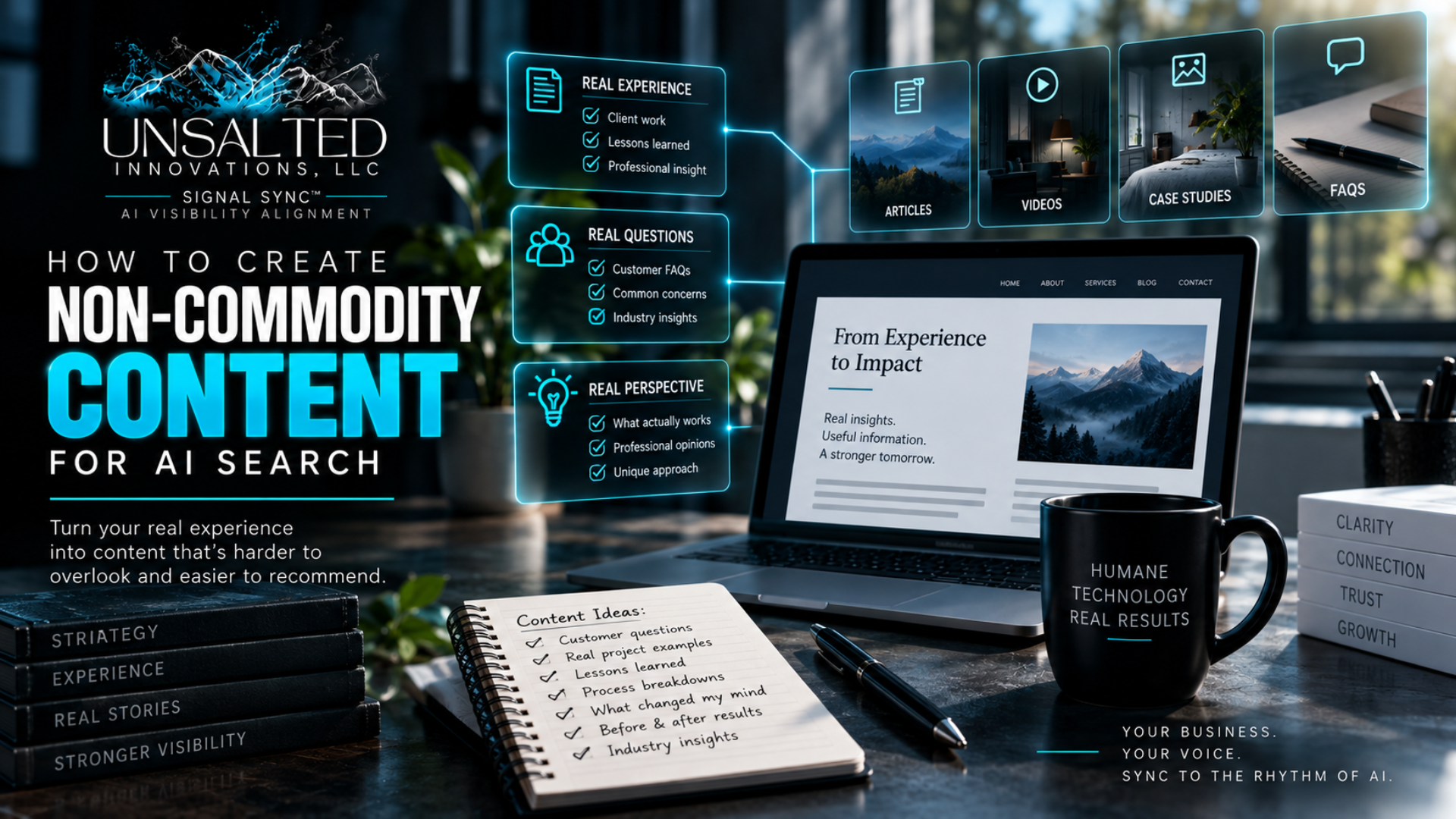
Google now uses the term non-commodity content in its official guidance for generative AI Search.
Its guidance encourages businesses to create useful information with a distinct point of view, firsthand experience, deeper knowledge, original research, and meaningful insight. Google also says businesses should avoid simply recycling information that already exists online or could easily be produced by a generative AI model.
For businesses, I think that creates a very practical opportunity.
You probably do not need to invent more expertise.
You may need to document more of the expertise you already use every day.
What Does Google Mean by Non-Commodity Content?
Commodity content is information that could reasonably come from almost anyone.
Think about articles such as:
“5 Tips for Choosing a Plumber”
“10 Reasons to Hire a REALTOR®”
“7 Benefits of Professional Marketing”
There may still be situations where a basic educational article serves a customer well.
The problem comes when an entire content strategy is made from information that another company could publish with almost no change besides the logo.
Google’s current generative AI optimization guidance specifically contrasts that type of common information with content built around firsthand experience, expert perspective, original analysis, and knowledge that adds something beyond what is already available.
A useful question I ask is:
Could another company in this industry replace our name with theirs and publish essentially the same article?
If the answer is yes, I start looking for what is missing.
There may be a real story.
A decision.
A customer question.
An observation.
A project.
A lesson.
A process.
A result.
A professional opinion.
That is usually where the more valuable content begins.
Your Best Content Ideas May Already Be Happening During the Workday
Business owners often tell me they do not know what to write about.
Then we start talking about their work.
Within twenty minutes, they have explained something they have encountered dozens of times, corrected a misconception customers regularly bring to them, described a decision they make differently from competitors, and told me a story about a project that almost went wrong.
That is content.
The reason it does not always feel like content to the business owner is because the knowledge has become normal to them.
You have answered the question so many times that you forget someone else does not know the answer.
You recognize the warning sign immediately because you have seen it repeatedly.
You know which part of a project usually causes trouble.
You know what customers misunderstand before they hire someone.
You know what looks like a simple problem until you inspect it more closely.
That experience is valuable precisely because it is ordinary to you and unfamiliar to the person searching for help.
Start With the Questions Customers Actually Ask You
One of the easiest places to find useful content is inside real customer conversations.
Pay attention to questions such as:
“What happens if I wait?”
“How do I know which option I actually need?”
“Why does this cost more than the other one?”
“Is this normal?”
“Can this be repaired, or does it need to be replaced?”
“What should I do before you arrive?”
“How long does this usually take?”
“What happens after this step?”
“What should I look for when comparing providers?”
These questions have context behind them.
The stronger article is often not simply an FAQ answer.
It is the explanation you give after someone asks the question.
Maybe you explain why the answer depends on the age of the house.
Maybe you tell them about something you commonly find during inspections.
Maybe you explain why one option sounds cheaper initially but creates a different problem later.
Maybe your experience has changed the recommendation you give now.
That is where the content becomes yours.
Document the Decisions You Make During Real Projects
Some of the strongest expert content is hidden inside decisions.
A finished project photograph shows the result.
It does not always show why the professional made the choices that produced it.
A designer may explain why she kept one existing piece of furniture and replaced another.
A plumber may explain why a recurring leak pointed toward repiping instead of another isolated repair.
A REALTOR® may explain why one offer strategy made more sense for a particular property than the advice someone would normally hear online.
A consultant may explain why she decided not to rebuild a client’s entire website after an audit.
Those decisions reveal judgment.
And professional judgment is difficult to recreate without experience.
When you document the reasoning, the content becomes much more useful than simply saying:
Here is what we did.
You can explain:
What did you notice?
What options were considered?
What influenced the decision?
What would have changed the recommendation?
What happened afterward?
That gives a reader access to part of the thinking behind the service.
Turn Client Work Into More Than Testimonials
Testimonials are valuable.
Case studies can take that proof much further.
A testimonial may tell someone:
“They did a great job.”
A useful case study can show:
what the original problem looked like
what information was missing
what was discovered during the project
what decisions were made
what changed
what the client experienced
what results were measured
what remained outside your control
what you would carry into a similar project in the future
The useful part is not simply proving success.
You are creating a documented example of how you think and work.
That can strengthen the service page connected to the project, give future customers something meaningful to evaluate, and create original information that did not exist online before the work was documented.
Write About the Things Experience Changed Your Mind About
This is one of my favorite content opportunities because it almost automatically creates a point of view.
Ask yourself:
What did I believe when I started this work that I approach differently now?
Maybe experience taught you that a common shortcut creates problems later.
Maybe you once recommended a particular process until repeated client work showed you a better approach.
Maybe you discovered that customers were focusing on the wrong metric.
Maybe something your industry treats as universally important turns out to matter much less in the situations you actually encounter.
You do not need to manufacture a controversial opinion.
A thoughtful change in professional judgment can be enough.
The point is to explain why your perspective developed.
That gives the reader something more meaningful than another article summarizing standard industry advice.
Use Real Comparisons When You Actually Have Criteria to Compare
Comparison content can be extremely useful when it comes from real evaluation.
For example:
When would I recommend one website platform over another?
When does a plumbing repair make more sense than replacement?
When does staging with existing furniture work better than bringing in additional pieces?
When is an AI visibility audit enough, and when does the website need deeper implementation?
The value comes from the criteria.
Explain what would make you choose Option A.
Explain what would make you choose Option B.
Explain the tradeoffs.
Explain the situations where neither choice is appropriate.
That kind of comparison helps the person make a decision.
It also gives them insight into the way you evaluate the problem professionally.
Your Framework Can Become Content When the Thinking Behind It Is Real
A named framework alone does not create authority.
The value is in the thinking behind it.
I created Signal Sync™ after repeatedly finding the same kinds of disconnects in client work.
A business could have strong reviews while the website barely showed why customers trusted it.
An owner could explain a service clearly in conversation while the online description remained vague.
Useful expertise could exist without being documented anywhere.
Technical website problems could make otherwise valuable information harder to find.
Older profiles could describe a previous version of the company.
Those observations eventually became the six Signal Sync™ pillars:
Website Clarity
AI Visibility Language
Trust Signals
Extractability
Voice Alignment
Visibility Structure
The framework gives me a way to organize what I am observing.
The content around it becomes useful when I explain what led to those ideas, how they appear in real work, where they apply, and where the limits are.
That is very different from creating a branded acronym and repeating it across dozens of pages.
Original Data Does Not Have to Mean a National Research Study
When people hear “original research,” they sometimes imagine needing thousands of survey responses.
Businesses can have useful original information on a much smaller scale.
You may have:
website analytics from a project
before-and-after performance
customer survey responses
frequently reported problems
project timelines
sales patterns
booking trends
conversion observations
common objections
product-return reasons
questions collected during consultations
results across a defined group of projects
The key is to be accurate about what the data represents.
If the sample is one client project, say that.
If results cover the first month after implementation, say that.
If something is an observation rather than a controlled study, describe it as an observation.
Good original content does not require making the evidence sound bigger than it is.
Firsthand Images and Video Can Strengthen the Story Too
Google’s generative AI optimization guidance also encourages publishers to support useful text with relevant, high-quality images and video where they genuinely help the person using the page.
For a business, that could mean:
real project photography
before-and-after images
screenshots demonstrating a process
a walkthrough
a product demonstration
a diagram you created to explain something
a short video answering a recurring customer question
an annotated example
behind-the-scenes documentation
The visual should add information.
A stock photo of someone pointing at a laptop probably does not teach the reader anything about how your company approaches the work.
A real example often can.
Make the Author and Experience Behind the Content Clear
Google’s broader guidance around helpful, reliable, people-first content asks publishers to consider whether content provides original information, useful analysis, clear sourcing, evidence of expertise, and background about the person or organization responsible for the content.
Google specifically encourages accurate authorship information where a reader would expect it.
That is one reason I have become more intentional about author information on my own resources.
If an article represents my professional analysis, I want it connected to me.
If a client is contributing firsthand expertise to a piece, I want their role and experience represented accurately.
Authority becomes easier to evaluate when the reader understands who is speaking and why that person has something useful to contribute.
AI Can Help You Build the Content Without Becoming the Source of the Expertise
I use generative AI as part of my own workflow.
Google does not prohibit that.
Its guidance on using generative AI content specifically says AI can be useful for researching a topic and adding structure to original material. Google emphasizes accuracy, quality, relevance, and adding real value rather than mass-producing pages.
That distinction makes sense to me.
AI can help me:
organize notes
identify questions I have not answered yet
research supporting documentation
compare possible structures
find repetition in a draft
turn a long conversation into themes
develop a useful outline
check whether an explanation needs more context
The knowledge still needs a source.
If I am writing about something a plumber encounters in the field, the plumber should supply the field experience.
If I am documenting a real estate transaction, the REALTOR® should supply the professional context.
If I am explaining Signal Sync™, that perspective should come from the work that led me to create it.
The technology can support the process without pretending it lived the experience.
That is one of the clearest examples of what I mean by Humane Technology.
How I Decide Whether a Blog Idea Is Worth Publishing
Before I build a full article, I would ask:
Does someone I actually serve need this information?
Do we have something meaningful to add?
Can we connect the subject to firsthand experience, original analysis, evidence, or professional judgment?
Is the answer substantial enough to deserve its own page?
Would the information be more useful inside an existing service page or FAQ instead?
Can I explain why this business is qualified to answer the question?
Will the reader understand something useful after reading it that they probably did not understand before?
If I cannot find a strong reason for the page to exist, I do not think a keyword alone is enough.
Google’s people-first content guidance makes a similar point. It encourages site owners to create material for an existing or intended audience, demonstrate firsthand expertise and depth of knowledge, and leave readers feeling that they learned enough to move toward their goal.
You Do Not Need a Separate Article for Every Search Variation
This is especially relevant now that Google has documented query fan-out in its generative Search systems.
A single search can lead Google to retrieve information around several related questions and subtopics.
That does not mean your content calendar needs one article for every possible variation.
Google explicitly warns against producing large quantities of pages primarily to capture those variations and says its systems can understand relevance even without an exact query match on the page.
I would rather build meaningful depth around the real subject.
A service page can answer several related customer questions.
A substantial guide can cover connected concepts.
A case study can contain process, results, expertise, and practical lessons.
A useful article can answer one meaningful question thoroughly without needing six nearly identical companion posts.
That approach also makes the website easier for people to use.
What Non-Commodity Content Could Look Like for Different Businesses
The format will vary by industry.
Local Service Business
Instead of:
“5 Signs You Need a Plumber”
the business might document:
“What We Usually Find After a Knoxville Homeowner Has Repaired the Same Leak More Than Once”
Now the article can include actual observations, local housing context, repair considerations, and professional judgment.
REALTOR®
Instead of:
“10 Tips for Buying a Home”
the agent might explain:
“The Three Questions My Knoxville Buyers Usually Start Asking Once They Are Serious About a Neighborhood”
That comes directly from customer experience.
Interior Designer or Home Stylist
Instead of:
“Benefits of Hiring an Interior Designer”
the designer might document:
“What I Keep, Move, and Replace During a Home Styling Walk-Through and Why”
That gives someone access to the actual process.
Boutique
Instead of another general seasonal trend article, the owner might answer:
“Why Customers Keep Choosing This Dress for Different Body Types and What I Tell Them About Fit”
The article can bring together product knowledge and real customer interactions.
Consultant
Instead of:
“Why Marketing Strategy Is Important”
the consultant might write:
“Three Things I Look at Before Telling a Business It Needs More Content”
That shows the professional decision process.
These subjects are more specific because the business itself gives us something specific to say.
How Non-Commodity Content Supports AI Visibility
There is no guarantee that publishing one excellent article will cause an AI platform to recommend your business.
That is not how I would present this work.
For Google specifically, the reason this matters is much more grounded.
Google says its generative Search experiences draw from its Search index and existing ranking and quality systems. It also says useful, original non-commodity content is likely to influence a site’s long-term presence in those experiences more than the other recommendations in its current guide.
That makes original expertise part of a larger visibility foundation.
The page still needs to be discoverable.
The website still needs a healthy technical structure.
The information still needs to be accurate.
Trust and supporting evidence still matter.
The business still needs to make sense.
Content is one piece of that system.
If you want to understand how all of those pieces connect, my SEO for AI Search: What Google Actually Says Businesses Should Focus On article explains the Google Search foundation in more depth.
The Complete AI Visibility Guide explains the broader Signal Sync™ methodology across search and AI-assisted discovery.
Where Non-Commodity Content Fits Inside Signal Sync™
This kind of content touches several Signal Sync™ pillars at once.
Voice Alignment is probably the most obvious.
I want the observations, knowledge, experience, process, and point of view behind the business to remain visible.
Trust Signals matter because real projects, results, sources, credentials, and supporting evidence help readers evaluate what is being said.
AI Visibility Language helps connect that expertise to the real service and customer need in clear language.
Extractability helps organize the information so important ideas can be located and understood accurately.
Visibility Structure connects the content back to relevant service pages, related resources, authorship, and the larger website.
The article is not valuable because we checked six boxes.
The framework helps me make sure useful expertise does not become another isolated blog post sitting by itself.
About the Author

I'm Brianna Sybesma, founder of Unsalted Innovations, LLC and creator of Signal Sync™ AI Visibility Alignment.
My work brings together website strategy, modern SEO, content development, marketing, brand clarity, technical systems, and AI-assisted search.
One of the patterns that led me to Signal Sync™ was realizing how frequently the strongest information about a business never made it online.
I could hear expertise clearly during a client conversation, then open the website and find almost none of that context represented there.
That gap continues to influence the way I approach content today.
My goal is to use technology to help businesses communicate more of what they genuinely know while keeping the experience, perspective, voice, and people behind the information intact.
Unsalted Innovations is based in Knoxville, Tennessee, and I work with businesses throughout the United States.
Learn more about Brianna Sybesma and Unsalted Innovations.
Written and reviewed by Brianna Sybesma
Creator of Signal Sync™ AI Visibility Alignment
Last reviewed September 2026
Your Business Probably Knows More Than Your Website Shows
You do not need another thirty generic blog ideas just to say you are publishing content.
You need to identify the questions, decisions, experiences, proof, and knowledge that belong to your business and determine where that information should live online.
That is part of what I look for during the Signal Sync™ AI Visibility Audit.
If the larger website needs content development, service-page restructuring, authority resources, internal linking, and deeper implementation, I can also carry that work into Signal Sync™ Website + AI Visibility Implementation.
Your business. Your voice. Sync to the rhythm of AI.