SEO for AI Search: What Google Actually Says Businesses Should Focus On
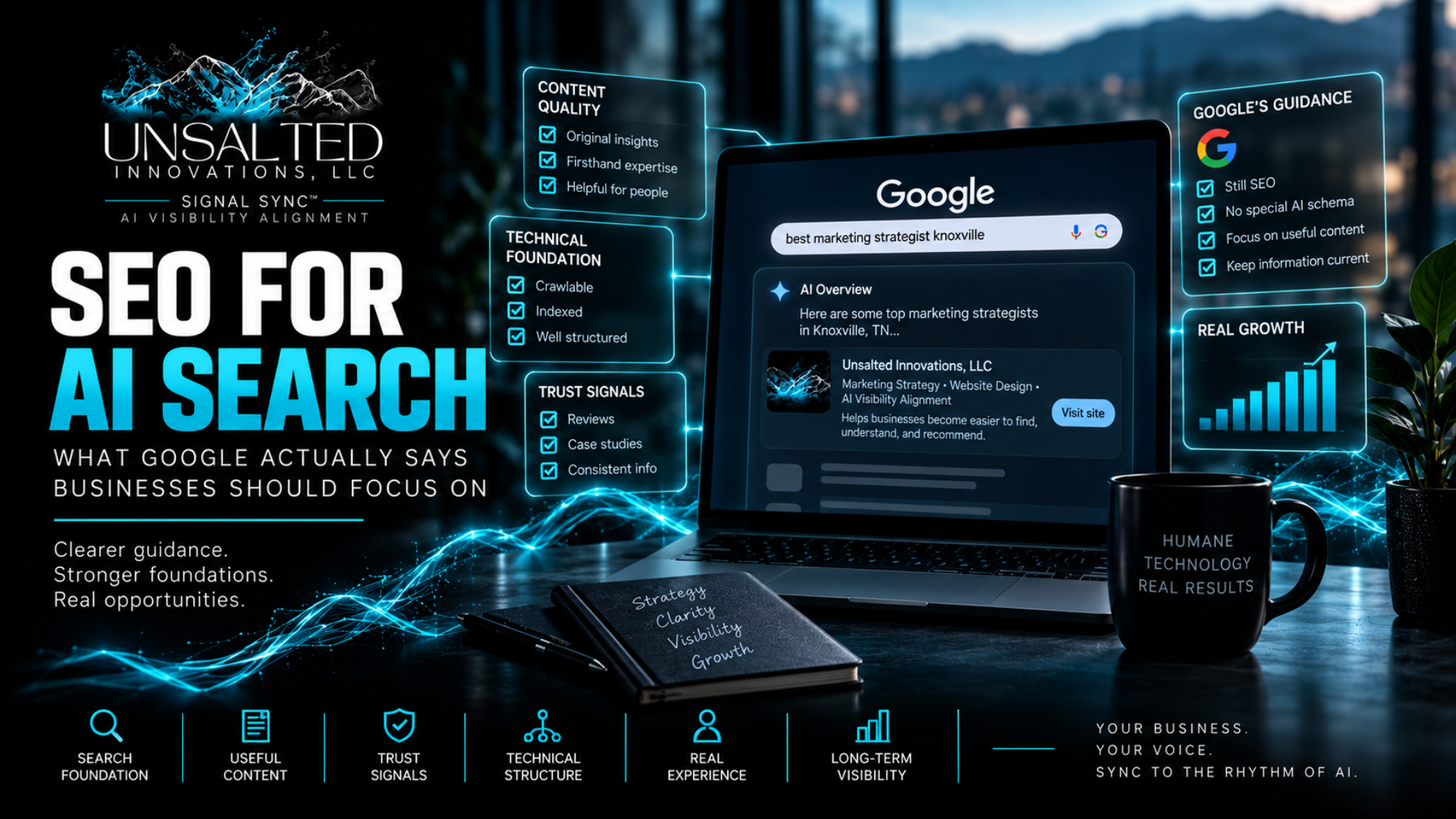
There is no shortage of advice about optimizing a website for AI search.
Some of it is useful.
Some of it comes from legitimate testing.
Some of it turns an emerging idea into a rule long before the platforms themselves have confirmed it.
When I am making recommendations for a business, I want to know which category I am working with.
Google gives us an unusually useful reference point because it now publishes specific guidance for businesses that want to appear in generative Search experiences such as AI Overviews and AI Mode.
Its position is straightforward:
SEO is still relevant to generative AI search.
Google says its generative Search features are rooted in its core Search ranking and quality systems. It uses techniques such as retrieval-augmented generation and query fan-out to retrieve relevant information from the Search index and support generated responses.
Google also says that, from its perspective, optimizing for generative AI Search is still optimizing for the Search experience and is therefore still SEO.
That matters.
It gives businesses something more useful to build from than trying to implement every new tactic labeled AEO, GEO, AI SEO, or LLM optimization.
I use that documented foundation alongside the broader work I do through Signal Sync™ AI Visibility Alignment.
First, This Guidance Is About Google
There is an important distinction I want to make before going further.
Google can tell us how Google Search works.
Its documentation does not tell us the internal ranking, retrieval, or recommendation systems used by ChatGPT, Perplexity, Claude, Gemini outside of Google Search, or every other AI platform.
Those products may use different models, sources, retrieval systems, partnerships, search indexes, and decision processes.
So when I say, “Google says this matters,” I mean exactly that.
I do not turn Google documentation into a universal rule for every AI system.
What Google's guidance does give us is a much stronger understanding of how established SEO connects with AI Overviews and AI Mode and which practices businesses do not need to invent specifically for those experiences.
For the broader picture beyond Google, I keep those distinctions together in my Complete AI Visibility Guide.
1. Foundational SEO Still Matters
This may be the most important place to begin.
Google's current generative AI optimization guidance says existing SEO best practices continue to be relevant because its generative AI Search features depend on core Search ranking and quality systems.
That means the basic Search foundation did not suddenly become irrelevant when AI-generated responses appeared.
I still care whether an important page can be crawled.
I still care whether it is indexed.
I still care whether related pages are connected through internal links.
I still care whether the website works properly across devices.
I still care whether important information is available as actual page content.
I still care whether Google can determine which version of a page belongs in Search.
I still care about the overall usefulness and quality of the information.
Google's separate guidance for AI features and your website says there are no additional technical requirements simply to appear as a supporting link in AI Overviews or AI Mode. A page needs to satisfy the normal technical requirements for Google Search, including being indexed and eligible to appear with a snippet.
For a business investing in AI visibility, that is important context.
A new AI tactic does not compensate for an important service page Google cannot properly access or index.
2. Google Is Putting Significant Emphasis on Non-Commodity Content
This is the part of Google's current guidance I think businesses should pay very close attention to.
Google says creating unique, compelling, and useful content is likely to influence a website's long-term presence in generative AI Search more than the other recommendations in its guide.
It specifically talks about non-commodity content.
That means information that contributes something beyond another summary of what everyone else online has already said.
For a business, that might come from:
years of firsthand experience
patterns noticed across real customer work
original research or data
a documented client project
a professional opinion shaped by experience
a process the business has developed
an unusual customer question
a decision made during a project and the reasoning behind it
a case study showing what actually happened
a perspective someone without that experience would struggle to reproduce
This is also consistent with Google's broader guidance around helpful, reliable, people-first content, which asks publishers to consider originality, expertise, sourcing, usefulness, and whether the content provides substantial value to the person reading it.
This is one of the reasons my content work with clients increasingly begins with the real business.
I want to know what you have learned.
I want to know what customers ask you.
I want to know what you notice that someone outside your field would miss.
I want to know what happened during actual projects.
That information is much harder to replace with another generic article.
3. Query Fan-Out Creates an Opportunity for Subject Depth
Google has also confirmed that AI Mode and AI Overviews can use a technique called query fan-out.
A person's original question can lead Google's systems to issue several related searches across subtopics and data sources while building a response.
I think this is useful for businesses to understand.
It does not mean we should create a separate page for every hypothetical fan-out query.
Google specifically cautions against creating large volumes of pages simply to capture every possible search variation. Its systems can understand relevance even when the page does not contain an exact match for every wording someone might use.
The more useful question is whether your website contains enough real depth around the subjects your business genuinely knows.
For example, a plumber may have meaningful information about:
water heaters
tankless systems
repiping
drain problems
leaks
water pressure
older plumbing systems
common homeowner questions
local plumbing conditions
real repair scenarios
Those subjects can connect naturally because they come from the work the business actually performs.
A consultant may have a completely different knowledge network around strategy, implementation, client decisions, measurement, common mistakes, tools, and professional judgment.
That creates depth without manufacturing content simply to fill URLs.
4. Your Technical Structure Still Supports AI Search Visibility
Google's generative AI guide has an entire section devoted to maintaining a clear technical structure.
Its guidance includes crawlability, Search technical requirements, page experience, JavaScript considerations, duplicate content, Search Console, and established technical SEO practices.
Google's AI-features documentation also specifically calls out:
allowing crawling
making content findable through internal links
providing a good page experience
making important information available in text
using relevant images and video
keeping structured data consistent with visible content
keeping Google Business Profile and Merchant Center information current when applicable
That list is much less mysterious than some AI optimization conversations make it sound.
A lot of the work is still good website work.
Can the page be found?
Can someone use it?
Is the important information actually there?
Are related pages connected?
Does the structured information accurately match what the visitor sees?
Does the site still represent the current business?
These are also questions I evaluate through the Visibility Structure pillar of Signal Sync™.
5. Internal Linking Deserves More Attention Than It Usually Gets
Internal linking is one of those things businesses often understand conceptually and barely use strategically.
A website may contain a service page, three related articles, a case study, an About page establishing the owner's expertise, and customer proof connected to the same subject.
None of them link to one another.
Google explicitly recommends making content easy to find through internal links as part of the SEO practices that remain relevant to its AI features.
I think about those links from the reader's perspective first.
What would help someone continue understanding this subject?
That is why this article does not need to explain my entire AI visibility methodology.
If you want the larger framework, the Complete AI Visibility Guide goes deeper.
If you want practical implementation steps, How to Improve AI Visibility for Your Business covers that separately.
If you have a specific technical question about schema, llms.txt, AI-generated content, AEO, GEO, or measurement, my AI Search Questions for Businesses resource is the better destination.
Each page has a distinct job.
The links connect the knowledge rather than forcing one article to do everything.
6. Google Does Not Require a Special Writing Style for AI
This is another misconception Google addresses directly.
You do not need to rewrite your website into some artificial “AI-readable” dialect for Google.
Its guidance says its systems can understand synonyms, general meaning, and relevant content even when the page does not use exactly the same language as the search query.
That does not mean language clarity stops mattering.
A vague page is still a vague page.
If a customer cannot figure out what your service actually is, I still want to improve it.
But there is a difference between making a business more specific and forcing every possible search variation into the copy.
Through Signal Sync™, I call this AI Visibility Language.
I look at whether the website naturally connects the real service, customer need, expertise, location, process, and relevant questions.
The goal is clarity with enough context to make the subject understandable while still sounding like the real business.
7. Google Does Not Require Artificial “Content Chunking”
You may also hear advice that every paragraph needs to be extremely short because AI systems supposedly require information to be broken into tiny independent chunks.
Google says there is no such requirement for its generative Search features.
Its systems can understand multiple topics and nuance on a page, and Google says there is no ideal page length.
That does not mean structure is unimportant.
People appreciate descriptive headings, logical sections, readable paragraphs, and information that is easy to navigate.
I use those things because they improve the experience of the page.
I do not structure every sentence around a theoretical extraction formula.
That distinction is also important to the way I define Extractability inside Signal Sync™.
Extractability is my term for how easily important information can be located, understood, and used accurately.
Good organization can support that without turning human writing into a series of disconnected machine-ready fragments.
8. Google Says You Do Not Need llms.txt for Search
llms.txt has received a lot of attention in AI visibility conversations.
Google addressed it directly.
Google Search does not use llms.txt files for ranking or visibility, and Google says having one neither helps nor hurts a site's visibility in Google Search.
That does not mean another platform could never use an emerging machine-readable standard.
Technology will continue developing.
It means I would not tell a business that adding llms.txt is required to improve Google AI Overviews or AI Mode visibility.
That is the kind of distinction I want clients to understand before they spend money implementing something.
9. There Is No Special AI Schema Required for Google
Structured data still has a valid role in SEO.
Google uses supported structured data to better understand certain information and determine eligibility for various Search experiences.
But Google explicitly says structured data is not required for generative AI Search, and there is no special Schema.org markup businesses need to add for AI Overviews or AI Mode.
This is why I use schema selectively.
Organization information should accurately describe the organization.
Article markup should accurately describe an article.
Service information should reflect the service that is actually visible on the page.
Adding more properties simply because they exist does not automatically make a website more authoritative.
Structured data should support the page.
It should not be presented as a hidden AI-ranking lever.
10. Google Warns Against Manufacturing Mentions
There is another idea circulating in AI visibility conversations that businesses need to manufacture large numbers of mentions across the internet to influence AI recommendations.
Real third-party context can absolutely matter.
Reviews matter.
Media coverage matters.
Professional profiles matter.
Industry references matter.
Customer discussions matter.
Credible citations and genuine recognition can add context around a company.
Google's guidance specifically warns against seeking inauthentic mentions as an optimization tactic. Its generative Search experiences still depend on ranking and spam systems designed to evaluate quality and reduce manipulation.
For me, that means authority building should have a real reason behind it.
A business being featured because it did interesting work is useful.
A founder contributing genuine expertise to an industry publication is useful.
Customers talking about their actual experiences is useful.
Manufacturing references solely to create the appearance of authority is something entirely different.
11. Google Still Wants Accurate Local Business Information
This one matters especially for local service businesses.
Google says its generative responses may include information about local businesses and specifically recommends keeping Google Business Profile information current.
That includes the basics businesses sometimes overlook while focusing on more advanced AI strategies.
Are your hours accurate?
Are the categories still appropriate?
Does the business description reflect what you offer today?
Is the website connected correctly?
Do the services make sense?
Is the location or service area accurate?
Are older details creating contradictions elsewhere?
For a local business, those details are part of the visibility foundation.
For a nationwide business, the same principle applies differently.
If the company now serves clients throughout the United States while older website and directory language still makes it appear limited to one region, that deserves attention too.
Accuracy comes before optimization.
12. AEO and GEO Are Useful Terms, but Google Does Not Treat Them as Separate Search Systems
AEO stands for Answer Engine Optimization.
GEO generally refers to Generative Engine Optimization.
These terms are useful shorthand for conversations about visibility inside answers and generative experiences.
I use them when they help describe what someone is asking about.
Google's current position is still important to understand.
From Google's perspective, optimization for generative AI Search is optimization for the Search experience and is therefore still SEO. Google specifically recommends evaluating third-party AEO and GEO advice against established Search guidance.
So I do not build a separate fictional Google ranking system and call it GEO.
Modern SEO remains part of Signal Sync™.
The broader AI Visibility Alignment work becomes useful because a business also exists beyond an individual Google result.
Its website, reviews, professional profiles, case studies, media coverage, directories, social content, Google Business Profile, and other public information can all contribute to how the company is represented online.
That is the larger picture I am evaluating.
What Google’s Guidance Changed for Me
The most useful part of Google's newer guidance is not that it made me abandon everything I was already doing.
It helped create a clearer boundary between documented practices and AI-search theories that still need to be treated as theories.
When I review a business now, I am even less interested in chasing an optimization because someone posted that “AI loves” a certain format.
I want to know:
Is the important page accessible?
Is it indexed?
Is the service clearly explained?
Does the website contain anything genuinely useful from the company's experience?
Are related pages connected?
Is customer proof supporting the right claims?
Is old information conflicting with the business today?
Does structured data accurately describe the page?
Is the content actually worth publishing?
Can a real person use the website easily?
Those questions give me much more to work with.
They also keep the technology connected to the people the website was built for.
That is where my Humane Technology philosophy sits inside Signal Sync™.
I want technology to help the business communicate more clearly without turning the business into content created solely for machines.
What Should Businesses Focus on First?
If you are trying to strengthen your website for Google Search and its AI features, I would work through the foundation in this order.
Understand whether your important pages are technically healthy and indexed.
Make sure the current website accurately represents the business.
Strengthen important service information where genuine context is missing.
Connect related pages through useful internal links.
Bring more firsthand knowledge and experience into the website.
Connect trust signals and real proof to the claims they support.
Correct outdated information across relevant business profiles.
Use structured data where it accurately supports the page.
Measure what is happening before assuming an AI tactic caused a result.
Then continue publishing when you have something useful to contribute.
That is much closer to what Google is actually documenting than trying to implement a collection of secret AI-search hacks.
If you want the practical version of this process, read How to Improve AI Visibility for Your Business next.
How Signal Sync™ Fits Into SEO for AI Search
SEO is part of Signal Sync™ because the website still needs a healthy Search foundation.
Signal Sync™ expands the review through six connected pillars:
Website Clarity looks at how clearly the business and services are communicated.
AI Visibility Language looks at whether the natural language provides enough context around the services, customer needs, expertise, and positioning.
Trust Signals looks at the evidence supporting the company's claims.
Extractability looks at how easily important information can be located and understood accurately.
Voice Alignment protects the firsthand knowledge, personality, perspective, and experience behind the business.
Visibility Structure looks at the technical and relational foundation connecting the content.
Those areas give me a way to apply current SEO guidance while still looking at the larger digital presence around the business.
You can see the complete methodology in my AI Visibility Overview.
About the Author
I'm Brianna Sybesma, founder of Unsalted Innovations, LLC and creator of Signal Sync™ AI Visibility Alignment.
My work brings together website strategy, modern SEO, content development, marketing, brand clarity, technical systems, and AI-assisted search.
Signal Sync™ grew from patterns I kept finding while working directly with businesses. Owners could often explain their services, experience, and customer needs with far more clarity than their websites or broader online presence communicated.
I created the framework to help close that gap while keeping the real people behind the business visible inside the process.
Unsalted Innovations is based in Knoxville, Tennessee, and I work with businesses throughout the United States.
Learn more about Brianna Sybesma and Unsalted Innovations.
Written and reviewed by Brianna Sybesma
Creator of Signal Sync™ AI Visibility Alignment
Last reviewed September 2026
Need to Know What Google Guidance Means for Your Website?
You do not need to implement every new AI optimization idea you encounter.
You need to know which gaps actually exist in your business's current digital presence.
The $297 Signal Sync™ AI Visibility Audit reviews your website and supporting online presence, identifies what deserves attention, and gives you a prioritized action plan grounded in the business you actually have.
Your business. Your voice. Sync to the rhythm of AI.