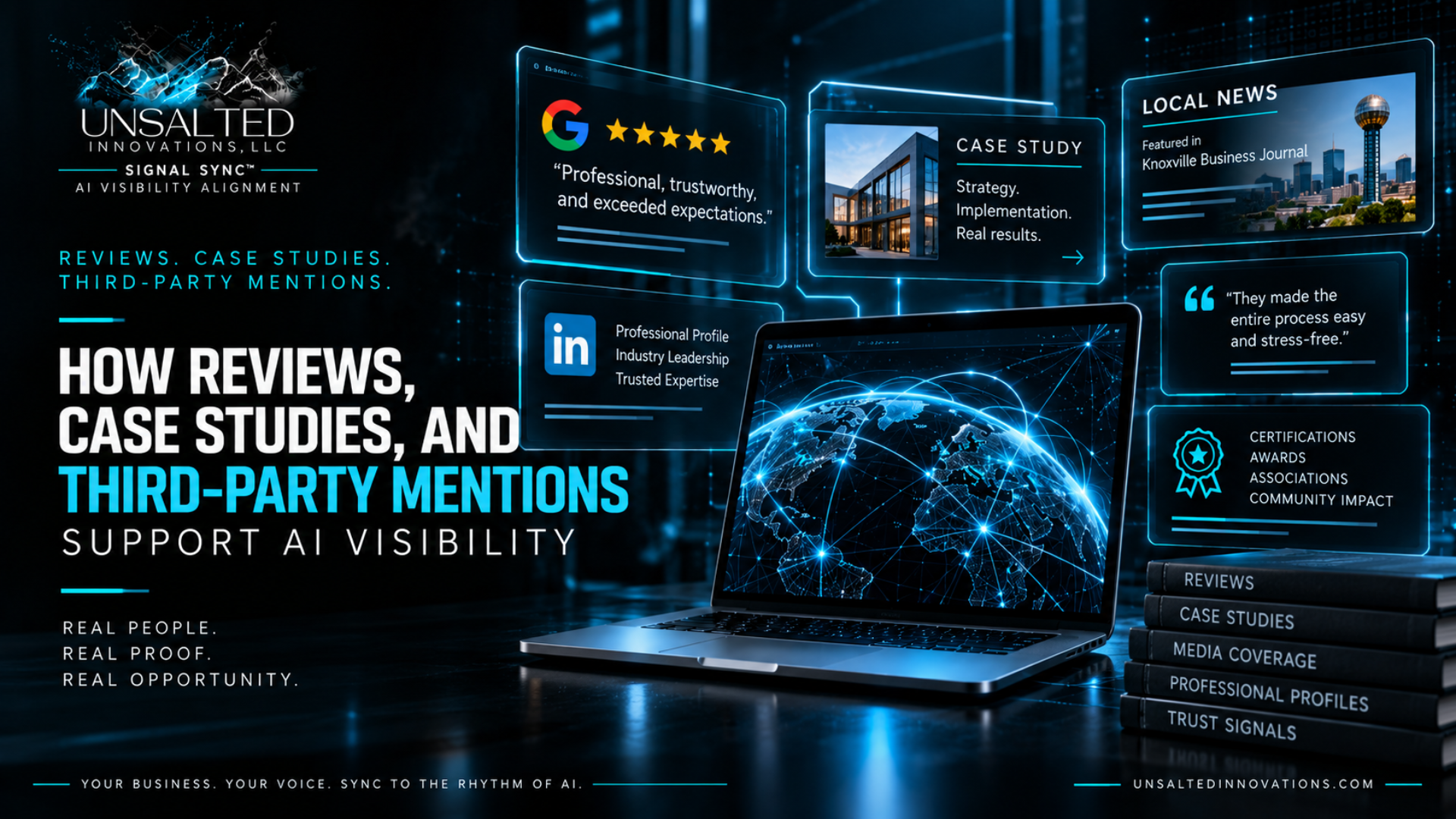
One of the things I notice during visibility audits is that businesses often have more credibility online than their websites actually use.
The Google reviews are strong.
Clients have described specific results.
The owner has been interviewed.
A local publication covered the business.
A professional profile explains years of experience.
There may be excellent project photos, client stories, awards, certifications, or community involvement.
Then I open the website and find:
“We provide high-quality service you can trust.”
The proof exists.
The website simply has not connected it to the claims being made.
That is why Trust Signals became one of the six pillars inside Signal Sync™ AI Visibility Alignment.
I am interested in the relationship between what a business says about itself and the information available to support it.
That matters for the person researching the company.
It can also create a richer, more accurate public picture for search and AI-assisted discovery.
What Do I Mean by a Trust Signal?
A trust signal is information that gives someone additional reason to understand or evaluate a business's experience, credibility, expertise, or real-world work.
That might include:
customer reviews
testimonials
case studies
documented client results
portfolio work
professional credentials
certifications
years of relevant experience
media coverage
podcast interviews
professional profiles
association memberships
awards
community involvement
third-party articles
original research
project examples
Not every business needs every one of those.
The point is not to decorate the website with as many credibility symbols as possible.
I want the evidence to have a relationship to what the business is actually asking someone to believe.
If you say you specialize in a particular service, what supports that?
If you say clients trust you for complicated projects, what examples show that?
If you say you have deep experience in a field, where can someone learn more about that experience?
That is where a trust signal becomes useful.
Reviews Can Tell You More Than Whether Customers Were Happy
Most businesses understandably think of reviews as reputation.
Five stars are good.
A negative review needs attention.
There is another layer I pay attention to.
What are customers repeatedly saying?
Maybe the website says:
We provide dependable plumbing services.
But the reviews repeatedly mention:
how quickly the company responded
how clearly the plumber explained the problem
how clean the crew left the home
how comfortable the homeowner felt asking questions
how the company solved a problem another provider had missed
That tells me something.
Customers may be identifying a meaningful strength the business has barely acknowledged in its own messaging.
The same thing can happen in any industry.
Clients may repeatedly describe a consultant as unusually thorough.
Patients may consistently mention how carefully a provider listens.
Real estate clients may talk about how calm an agent kept them during complicated negotiations.
Customers at a boutique may repeatedly mention help with fit and styling rather than simply the products themselves.
Those patterns can help a business understand what people actually value about the experience.
I do not copy reviews into every page.
I look at what they reveal.
Reviews Are Evidence, but I Would Not Call Them a Guaranteed AI Ranking Factor
This distinction matters.
Reviews can provide public information about a company.
They can influence human decisions.
For local businesses, reviews are part of the broader Google Business Profile ecosystem customers encounter while researching providers.
Different AI systems may also encounter review platforms or other public sources depending on how that particular product searches or retrieves information.
What I will not tell a business is:
Get 50 reviews and ChatGPT will recommend you.
The platforms have not given us a universal formula like that.
For Google specifically, its current generative AI guidance says generative features can show what is being said about products and services across the web, including information in blogs, videos, and forum discussions. Google also cautions businesses against seeking artificial mentions simply to manipulate visibility.
So I treat genuine customer feedback as useful evidence.
I do not turn it into a made-up ranking formula.
Case Studies Give Trust More Context
A testimonial tells someone what the client thought.
A case study can show what actually happened.
That difference is important.
A useful case study can explain:
where the client started
what problem needed to be solved
what was discovered during the work
which decisions were made
why those decisions were made
what changed
what results were measured
what those results do and do not prove
That last point matters to me.
A case study becomes more credible when the business is careful about causation.
If website traffic increased after implementation, I can report that.
If organic search sessions increased, I can report that.
I should not automatically claim that an AI platform caused those results unless the data actually supports that conclusion.
That kind of precision strengthens the case study rather than weakening it.
Case Studies Can Also Become Non-Commodity Content
This is where Trust Signals and Voice Alignment begin to overlap inside Signal Sync™.
A real project gives you information no competitor can reproduce exactly.
They did not have the same client.
They did not encounter the same starting point.
They did not make the same decisions.
They do not have the same results or observations.
That makes case studies one of the most natural ways for a business to create original, experience-led content.
Google's current generative AI guidance puts significant emphasis on non-commodity content built from firsthand experience, expert perspective, and unique information rather than another summary of common knowledge.
I explain that content strategy in more depth in How to Create Non-Commodity Content for AI Search.
The strongest case study is not a long advertisement.
It gives someone something useful to learn from the project.
A Real Example From Friendly Neighborhood Plumber
Friendly Neighborhood Plumber is a good example from my own work.
The business already had real expertise, customer relationships, established plumbing services, and local credibility.
The Signal Sync™ project gave us a way to represent more of that online.
We worked on clearer service information, stronger Knoxville-area context, website organization, internal linking, trust signals, and the relationship between the individual services and the larger business.
Then I documented the work.
The resulting Friendly Neighborhood Plumber Signal Sync™ case study gives someone more than a sentence saying the redesign was successful.
It shows what was changed and what happened during the first month afterward.
That gives future clients something concrete to evaluate.
It also creates a piece of firsthand information about my own methodology that did not exist before the project was documented.
Third-Party Mentions Can Add Context You Cannot Create for Yourself
There is something fundamentally different about saying:
We are respected in our industry.
and having someone else independently reference your expertise.
That third party might be:
a local publication
an industry publication
a podcast
a professional organization
a conference
a community organization
another business
an expert interview
a news outlet
a university
a directory with meaningful editorial standards
The value comes from the fact that the source exists independently of your own website.
You do not control every word.
You did not publish the article on your own domain and then call it third-party authority.
That independence can give people researching the business additional context.
It may also give search or AI-assisted systems another public source where the business and its expertise are discussed.
Again, that does not mean every mention produces a measurable AI-ranking boost.
It means the public web contains more independent information about the business.
The Quality of the Mention Matters More Than Collecting Mentions
This is where I think businesses can get pulled into bad AI visibility advice very quickly.
If someone hears:
AI systems look at mentions across the web.
the next idea becomes:
Then I need as many mentions as possible.
That can lead to:
meaningless directory submissions
low-quality guest posts
fake profiles
artificial forum conversations
paid mentions with no real audience value
mass-produced articles built only to repeat the brand name
I would not build authority that way.
Google directly addresses this in its current generative AI optimization guidance.
Google says its generative Search features can surface information being discussed about products and services across the web, but it specifically advises against seeking inauthentic mentions. Its generative features still depend on ranking and spam systems designed to evaluate quality and reduce manipulation.
A meaningful interview is valuable because you had something worth discussing.
A genuine client review is valuable because someone actually worked with you.
A local news story is useful because something happened that deserved coverage.
A professional organization listing you as a member or speaker has context behind it.
Those relationships make sense without needing to manufacture them for an algorithm.
Professional Profiles Can Help Establish Who Is Behind the Expertise
This is another area I look at.
Sometimes the company website contains strong educational content, but the person responsible for that expertise is difficult to identify.
That can be especially noticeable for:
consultants
physicians and healthcare providers
attorneys
REALTORS®
designers
financial professionals
agency founders
coaches
tradespeople with specialized credentials
Professional profiles can add context around:
education
experience
credentials
specialties
professional history
organizations
published work
interviews
speaking
awards
The goal is not to create profiles everywhere.
It is to make sure the profiles that genuinely matter still reflect the person and business accurately.
This is one reason I have been intentional about connecting my own AI visibility articles to Brianna Sybesma, rather than leaving every authority article attributed only to Unsalted Innovations as a company.
Signal Sync™ is my framework.
If I am writing the methodology and professional analysis behind it, the authorship should make that clear.
Social Media Can Provide Context Without Becoming the Whole Authority Strategy
Social content is another part of the public picture.
A business may use social media to show:
projects
customer questions
behind-the-scenes work
events
professional opinions
community involvement
product knowledge
videos
client education
Those posts can reinforce what the business does.
I still do not want the most important information existing only on Instagram, Facebook, LinkedIn, or TikTok.
If a business develops a valuable explanation through a social post and the subject deserves a permanent place on the website, I often want to bring that knowledge back to the site too.
The website gives the business a more stable home for its own expertise.
Social platforms can reinforce that picture.
Trust Signals Should Be Connected to the Right Pages
A business can have excellent evidence and still use it poorly.
Imagine a company with:
30 reviews mentioning one specialty
three strong project photographs
a relevant credential
a case study
and five years of experience in the service
but the actual service page says almost nothing beyond:
Contact us to learn more.
That is a missed connection.
I may recommend bringing some of that evidence closer to the service itself.
Not all of it.
Enough to help someone understand why the company is qualified.
The case study can link to the service.
The service can link to the case study.
A relevant testimonial can appear where someone is already evaluating the offer.
A credential can be explained where it matters.
This is also where internal linking becomes part of the trust strategy.
The information works better when someone can follow the relationship.
Your About Page Is Part of the Trust Picture Too
The About page often gets treated like the personal story page.
It can be more useful than that.
Depending on the business, it can establish:
who is behind the company
professional history
why the business exists
relevant experience
credentials
the methodology
values
location
service reach
the connection between the founder and the company's expertise
This matters especially for a business where the founder's experience is closely tied to the service.
Someone researching Signal Sync™ should be able to understand that Brianna Sybesma created the framework, that it belongs to Unsalted Innovations, and that my professional work sits behind the methodology.
That association should not depend on someone already knowing my name.
Reviews and Mentions Should Still Be Accurate
Trust can be weakened by outdated evidence too.
A profile may still use an old business name.
A directory may show the wrong location.
A media article might link to an old domain.
An outdated bio may describe services you no longer provide.
An old award page may identify a title that has since changed.
I do not expect to control every historical reference on the internet.
I do look at whether the most important current public sources still make sense together.
That is especially relevant when a business has changed significantly.
The stronger the public footprint becomes, the more useful it is to know what story those sources collectively tell.
How I Think About Trust During an AI Visibility Audit
I do not open an audit and count badges.
I am usually asking questions such as:
What claims is this business making?
What evidence supports those claims?
What do customers consistently say?
Are the strongest reviews connected to the right services?
Are there meaningful case studies?
Is the founder's expertise represented?
Are relevant professional profiles accurate?
Does third-party coverage exist?
Are older references creating confusion?
Does the website acknowledge real client results?
Are there opportunities to document more of the work?
What information would help someone evaluate this company before contacting them?
Those questions tell me much more than:
How many trust signals do you have?
Can Reviews and Third-Party Mentions Make ChatGPT Recommend Your Business?
They can contribute public context.
I would stop short of promising more than that.
ChatGPT Search can search the web and use public sources when answering questions. Other AI-assisted platforms have their own retrieval and recommendation systems.
None of that gives me permission to say:
Get mentioned on these five websites and ChatGPT will recommend you.
OpenAI does not provide that formula.
I explain what we can and cannot influence in Can ChatGPT Recommend Your Business? What You Can and Cannot Influence.
For me, the more useful strategy is making sure the public information around a business is accurate, meaningful, credible, and connected to real work.
Trust Signals Cannot Replace a Clear Business
There is another limit worth mentioning.
A company can have great reviews and still have an unclear website.
It can have media coverage and still have outdated service pages.
It can have industry credentials while making someone work far too hard to understand what it actually offers.
Trust Signals are one pillar inside Signal Sync™ for a reason.
They work alongside:
Website Clarity
AI Visibility Language
Extractability
Voice Alignment
Visibility Structure
The digital presence becomes stronger when those pieces support one another.
The review tells me the company is trusted.
The service page tells me what the company actually does.
The case study shows me how the work happens.
The About page tells me who is behind the expertise.
The website structure helps me find those pieces.
That is the larger picture I am trying to align.
What Should a Business Work on First?
I would start with what already exists.
Read your customer reviews.
Look for patterns.
List your strongest completed projects.
Identify results you can accurately document.
Review your professional profiles.
Search your business and founder name.
Look at existing media coverage.
Check whether important service claims are supported anywhere.
Then decide which information deserves a stronger home on the website.
You may discover that you do not need ten new authority tactics.
You already have meaningful proof.
It has simply never been organized around the services and expertise you want people to understand.
About the Author

I'm Brianna Sybesma, founder of Unsalted Innovations, LLC and creator of Signal Sync™ AI Visibility Alignment.
My work brings together website strategy, modern SEO, content development, marketing, brand clarity, trust signals, technical structure, and AI-assisted search.
Trust Signals became part of Signal Sync™ because I kept finding businesses where credibility already existed but was disconnected from the online story.
The reviews were there.
The experience was there.
The client work was there.
The proof was there.
The website was simply not using those pieces together very well.
My approach is rooted in Humane Technology, which means I want the digital presence to become clearer and more useful without manufacturing authority or stripping away the real people and relationships behind the business.
Unsalted Innovations is based in Knoxville, Tennessee, and I work with businesses throughout the United States.
Learn more about Brianna Sybesma and Unsalted Innovations.
Written and reviewed by Brianna Sybesma
Creator of Signal Sync™ AI Visibility Alignment
Last reviewed September 2026
Your Business May Already Have More Authority Than Your Website Shows
Before you start looking for new places to manufacture visibility, it is worth understanding what evidence already exists around your business.
Your reviews.
Your client work.
Your professional history.
Your case studies.
Your results.
Your relationships.
Your third-party coverage.
Your expertise.
The $297 Signal Sync™ AI Visibility Audit looks at those trust signals alongside your website, services, content, technical structure, and broader online presence so we can see what is already working and what needs to be connected more clearly.
Your business. Your voice. Sync to the rhythm of AI.